

How Artificial Intelligence, advanced automation, and Physical AI are redefining industrial production
We are experiencing a revolution so profound that
its impact is already being compared to the Industrial Revolution, and it may even surpass that historic benchmark of transformation.
Artificial Intelligence (AI) is no longer merely a promising technology; it is reshaping the way we live, work, and think
in a transversal and permanent way. Whether in education, finance, healthcare, communication, or industry, AI has entered
the daily lives of people and organizations so naturally that, in a few years, we may not even call it “AI” anymore,
just as we do not say “electricity” every time we turn on a light. It simply becomes part of the world and of
human routine.
Across many sectors, its presence is growing rapidly,
driving new ways of producing knowledge, delivering services, and making decisions. This evolution is not limited to major
technological centers but occurs in virtually every area where data, processes, and people interact.
At the same time, the speed of this transformation
raises an inevitable question: how will different sectors adapt to a world where intelligent systems collaborate with humans,
automate complex tasks, and expand the capacity for analysis and decision-making? Industry is one of the areas where this
change is likely to be deepest and most structural.
While digitalization has already been transforming
how factories operate over the past decades, the next phase of this evolution is being driven by Artificial Intelligence.
What was once simply programmed automation is now evolving into systems capable of learning from data, interpreting contexts,
and optimizing processes in real time.
This shift is not only technological. It involves
new production models, new professional skills, and even a redefinition of the concept of industrial work.
From automation to operational intelligence
For many years, the primary goal of industrial automation
was to increase efficiency. Robotic production lines and control systems reduced human error and increased productivity. However,
these technologies still relied on predefined rules and had limited ability to adapt.
With the introduction of Artificial Intelligence,
a new level of industrial operation emerges. Intelligent systems begin analyzing large volumes of data generated by sensors,
machines, and corporate systems to identify patterns that are invisible to human operators.
This makes it possible to predict equipment failures
before they occur, optimize the use of raw materials, reduce waste, and adjust production processes in real time. Predictive
maintenance, for example, is already changing how companies manage their industrial assets, preventing unexpected downtime
and increasing the lifespan of equipment.
The factory begins to behave like an intelligent
organism, capable of continuously learning from its own data.
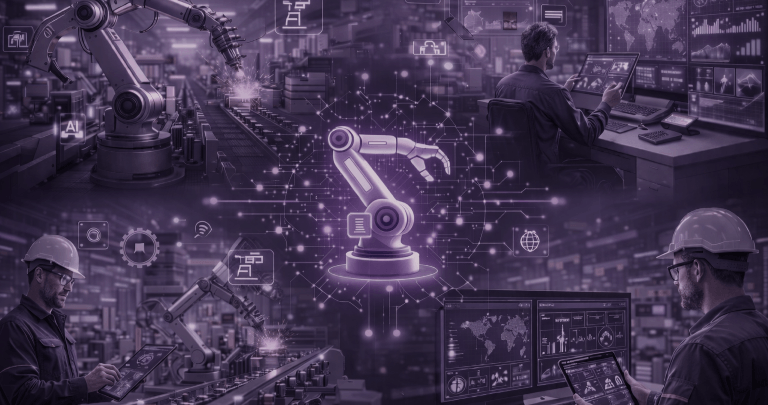
The rise of Physical AI
One of the most promising trends for the coming
years is what is known as Physical AI.
Unlike purely digital applications, this concept refers to Artificial Intelligence systems capable of interacting directly
with the physical world through sensors, robots, and connected devices.
In industry, this means machines capable of perceiving
their surroundings, interpreting visual information, recognizing operational patterns, and adapting their behavior. Industrial
robots, for example, are beginning to use computer vision and machine learning to manipulate objects with greater precision
and flexibility.
This evolution moves manufacturing closer to a model
where intelligent systems not only execute repetitive tasks but also actively participate in operational decision-making.
The combination of advanced robotics, intelligent
sensors, and AI creates more adaptable production environments capable of responding quickly to changes in demand, variations
in production processes, or even unexpected failures.
Data-driven factories
Another significant trend is the consolidation of
so-called data-driven factories. Industrial sensors, monitoring systems, and digital platforms generate ever-increasing volumes
of information about every stage of production.
When this data is analyzed using Artificial Intelligence
algorithms, new optimization opportunities emerge. It becomes possible to identify production bottlenecks, predict variations
in product quality, and continuously improve industrial processes.
Integration between systems such as ERP (Enterprise
Resource Planning), MES (Manufacturing Execution System), and analytics platforms also enables a broader view of operations,
connecting planning, production, and logistics into a more intelligent information flow.
This convergence between operational technology
and information technology creates the ideal environment for Artificial Intelligence to become an essential part of industrial
strategy.
Smarter and more resilient supply chains
The application of AI in industry is not limited
to the factory floor. Complex supply chains are also beginning to benefit from systems capable of predicting demand, identifying
risks, and dynamically adjusting logistics plans.
Advanced analytics models can anticipate market
fluctuations, suggest optimal inventory levels, and even reorganize logistics routes when unexpected events occur.
This becomes especially relevant in an increasingly
unstable global environment, where supply chain disruptions can significantly impact production.
Artificial Intelligence helps companies build more
resilient supply chains that can react quickly to change and minimize operational risks.
A new concept of industrial work
Perhaps one of the most profound transformations
brought by Artificial Intelligence is related to the very concept of work in industry.
Traditionally, industrial production has always
been associated with defined shifts and work schedules based on human working hours. With the growing presence of intelligent
systems, this logic begins to change.
Algorithms do not require breaks; they operate continuously
and can monitor industrial processes in real time, 24 hours a day. This opens the door to a more continuous operating model
in which the human role gradually shifts from executing tasks to supervising, analyzing, and making strategic decisions.
Rather than completely replacing human work, the
strongest trend is the expansion of human capabilities. Engineers, technicians, and operators increasingly work side by side
with intelligent systems, using data and insights to improve processes and drive innovation.
This collaboration between humans and machines tends
to redefine important skills in industrial environments, placing greater value on competencies related to data analysis, interpretation,
and technology management.
The industry of the future has already begun
The transformation driven by Artificial Intelligence
is not a distant scenario. In many industrial sectors, this change is already underway.
Companies that successfully integrate data, automation,
and analytical intelligence gain greater visibility into their operations and can make faster and more accurate decisions.
At the same time, implementing AI solutions requires
more than technology. It is necessary to deeply understand the company’s processes, identify application opportunities,
and build software architectures capable of supporting these solutions with security and scalability.
This is precisely where experience makes a difference.
Successful Artificial Intelligence projects combine business knowledge, robust software engineering, and the ability to transform
data into real value for organizations.
Industry has always been a driving force of economic
innovation. With Artificial Intelligence, it now enters a new phase in which efficiency, intelligence, and adaptability become
the pillars of production.
Companies that understand this movement and prepare
for it will be better positioned to lead the next generation of industrial transformation.
If Artificial Intelligence is already redefining
sectors such as education, finance, healthcare, and telecommunications, in industry it may represent something even greater:
the creation of truly intelligent production systems.
Visionnaire can be your partner
In this context of accelerated transformation, having
an experienced technology partner can make all the difference. With 30 years of experience in software development and advanced
technology solutions, Visionnaire helps industrial companies transform data into intelligence, automate critical processes,
and apply Artificial Intelligence in a strategic and secure way.
Whether creating intelligent systems, integrating
industrial platforms, or developing tailored solutions, Visionnaire supports organizations that want to increase operational
efficiency, innovate their production models, and prepare for the future of AI-driven industry. Contact
us to learn more.
This article is part of a special Visionnaire
series about the impact of AI across different sectors. You may also want to read:
- AI in Education: Trends for the Future
- AI in Finance: Trends for the Future
- AI in Healthcare: Trends for the Future
- AI in Telecommunications: Trends for the Future
- AI in Law: Trends for the Future
- AI in Human Resources: Trends for the Future


