

Artificial Intelligence is redefining software speed, and those who don't adapt will be left behind
For decades, software development has evolved in
cycles. First came the waterfall model, rigid and predictable. Then, in response to its limitations, the Agile Manifesto emerged:
a turning point that brought speed, collaboration, and continuous adaptation. It was a revolution. And it worked.
Scrum, sprints, backlog, incremental deliveries,
MVPs, continuous integration… all of this helped companies move away from slow processes and get closer to what truly
matters: delivering value quickly. But there is a point few are willing to admit: Agile is no longer agile. Not because it
failed. On the contrary, it fulfilled its role exceptionally well. The problem is that the context has changed. And it has
changed radically.
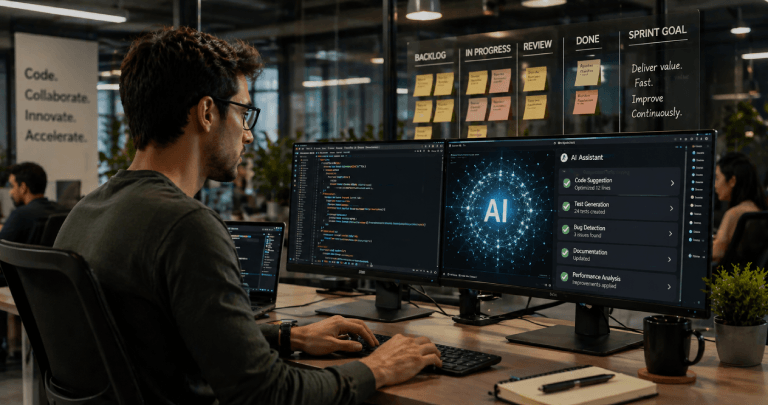
The arrival of Artificial Intelligence in software
development is not just another incremental innovation. It is an earthquake. An event that doesn’t simply improve the
existing process, but completely redefines its foundations.
The invisible limit: human dependency
Agile still depends, essentially, on people. And
people, no matter how talented they are, create friction. There are alignments, meetings, different interpretations, rework,
and natural communication bottlenecks. All of this is part of the human game and has always been acceptable in the previous
context. But AI doesn’t operate like that. It doesn’t get tired, doesn’t interpret things ambiguously, and
doesn’t need meetings to align understanding. It executes, learns, and adjusts at a speed that simply wasn’t possible
until recently. In practice, this changes everything.
When AI enters the scene, the game changes
Today, the concept of pair programming no longer
means two people side by side. In many cases, the most efficient “pair” is Artificial Intelligence itself, suggesting
code, correcting errors, anticipating problems, and accelerating decisions in real time.
Test-Driven Development, once a rigorous discipline
often neglected due to time pressure, gains a new dimension. With AI, tests can be generated, executed, and continuously adjusted
without the traditional human operational cost. The development cycle shortens. And not by a small margin.
What once took an entire sprint can now be done
in hours. What required multiple human interactions can be resolved in a single interaction with AI. The backlog is no longer
a manual prioritization funnel but becomes a dynamic flow, constantly recalibrated by intelligence. And this is where many
companies get stuck, because they try to fit AI into the traditional Agile model, when the necessary move is the opposite:
to rethink the process from scratch.
There is still no “definitive manual”
for AI-driven development. And there probably never will be. Books become obsolete too quickly given the speed of this evolution.
What we see today is a scenario where each organization is, in practice, creating its own model. This generates uncertainty,
but also a massive opportunity.
A new paradigm is being built
Companies that understand this shift are not just
adopting AI tools. They are reinventing how software is conceived, built, and delivered. They are drastically reducing the
time between idea and execution. They are eliminating layers of friction. They are creating a new paradigm.
At Visionnaire, this movement is already a reality.
With 30 years of experience in software development, the company has not only followed market transformations: it has evolved
with them. Today, AI is not a complement, but a central element in building faster, smarter, and more efficient processes.
What comes after Agile?
It’s not about abandoning Agile. It’s
about going beyond it. Recognizing that what was revolutionary yesterday can become limiting today. And understanding that,
in this new scenario, speed is not just about delivering faster. It’s about thinking, developing, and evolving at a
completely different pace.
The real question is not whether your company will
adopt AI in development. That is already happening. The real question is: is your process ready for this new level of agility?
Because in this new world, being Agile is no longer enough.
Visionnaire is agile in every sense
If your company has already realized that traditional
methods can no longer keep up with the speed demanded by the market, it may be time to take the next step. Visionnaire combines
three decades of software development experience with the practical application of Artificial Intelligence to create more
agile, efficient processes aligned with the future.
Want to understand how this can accelerate your
projects and generate real competitive advantage? Get in touch with Visionnaire and discover how to transform the way your company develops software.


