

Modern tools accelerate the beginning, but the real challenge is turning a prototype into a product. Learn how to evolve AI-created projects
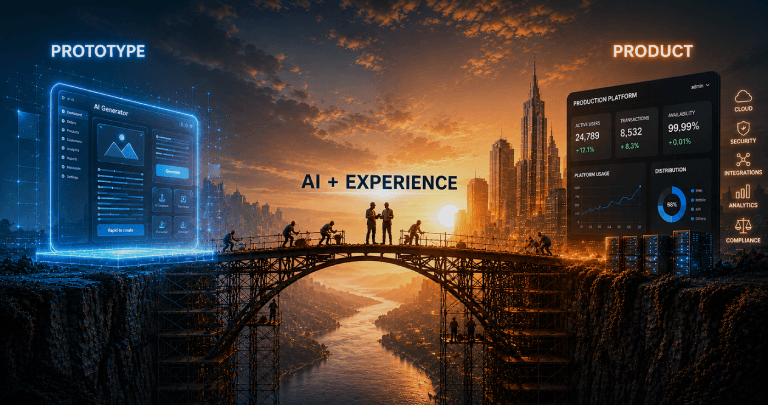
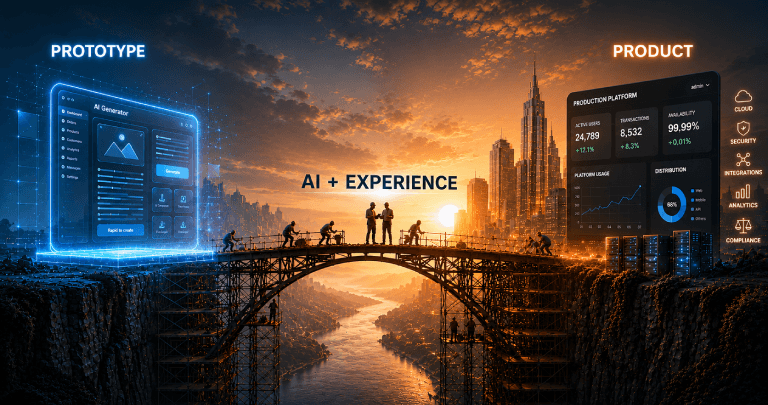
Over the past few months, tools like Lovable, Cursor,
Replit, v0, and several AI-assisted development platforms have radically changed the way digital products begin to take shape.
What once required weeks of development can now emerge in just a few hours. Ready-made interfaces, functional workflows, connected
integrations, and even seemingly complete applications are created almost instantly.
For startups, innovation teams, and entrepreneurs,
this feels like a dream come true. And, in fact, it is a huge leap forward. The problem begins when the prototype needs to
become a product. This is exactly where many initiatives get stuck. The initial excitement gives way to technical doubts,
structural limitations, and challenges that AI tools alone still cannot solve.
As we have already discussed in other Visionnaire
articles, there is a “60% trap”: AI dramatically accelerates the beginning of development, but tends to lose efficiency precisely in the final stretch,
where architecture, security, scalability, governance, and critical technical decisions come into play. The result is that
many initiatives quickly reach a functional demonstration, but do not know how to move forward from there.
The prototype worked. now what?
This is currently the most common scenario. You
managed to validate an idea, impress investors, test a solution with customers, or even launch an MVP (Minimum Viable Product)
using generative AI. Modern tools truly allow visually sophisticated applications with a strong initial user experience to
be created without relying on an entire development team. But a prototype is not born production-ready. In practice, it was
created to validate a hypothesis quickly, not to sustain growth, multiple users, complex integrations, or critical operations.
As the project gains relevance, inevitable questions
arise: Is the code maintainable? Can the architecture support growth? Is there adequate security? Are the integrations reliable?
Can the system scale? Is there governance over development? Is the application prepared for compliance, auditing, and data
protection regulations? Who will maintain it in the long term?
This is where many companies realize that building
fast is different from building properly.
AI’s biggest challenge is not starting.
it is continuing
Generative AI tools have revolutionized development because they drastically reduced the barrier to entry. Today, people without deep technical knowledge can structure entire products using prompts and coding agents. But there is an important difference between generating software and engineering software. AI can create components, interfaces, and features at incredible speed. However, real-world projects require much more than functional screens. They require:
·
Consistent architecture
·
Code standardization
·
Scalability strategy
·
Monitoring
·
Observability
·
Automated testing
·
Technical governance
·
Technical debt management
·
Information security
·
Integration with legacy systems
·
Performance optimization
·
Documentation
·
Continuous evolution processes
The most common mistake after creating an AI-based
MVP
Many companies believe they simply need to “keep
using AI” to evolve the system indefinitely.
How to turn an AI-created prototype into a real
product
The good news is that it is not necessary to abandon
everything that has already been built. In most cases, the right path is to conduct a structured evolution of the project.
The first step is performing a complete technical assessment of what has already been developed. Not every piece of AI-generated
code needs to be discarded. In many cases, there are reusable components, valid workflows, and structures that can safely
evolve.
After that comes a more mature software engineering
process. This involves reviewing architecture, reorganizing standards, validating security, structuring pipelines, creating
tests, documenting integrations, and ensuring the product can grow without compromising stability. Even more importantly,
it requires defining a continuous evolution strategy.
Modern projects do not end after launch. They evolve
constantly. That is why decisions made now directly impact future costs, innovation speed, and expansion capability.
AI accelerates. Experience sustains. Visionnaire
delivers both
There is one fundamental point many companies are
discovering right now: AI does not replace technical maturity. It enhances productivity, accelerates execution, and reduces
experimentation time. But transforming software into a strategic asset still requires engineering, architectural vision, and
practical experience. That is exactly where specialized companies make the difference.
At Visionnaire, we closely follow this market transformation.
We understand the enormous potential of AI tools in modern development, but we also know the real challenges involved in bringing
these solutions into production with security, scalability, and sustainability.
We have experience both in traditional software
development and in evolving projects started with generative AI. This means we can act precisely at the point where many projects
get stuck: the transition between prototype and product. Contact us
and learn more.
The future belongs to those who can cross the
final 40%
The democratization of development through AI is
only beginning. More and more companies will be able to create prototypes rapidly. More and more ideas will leave the drawing
board in record time. But competitive advantage will not come only from starting quickly. It will come from being able to
evolve, structure, scale, and transform a functional demonstration into a reliable, sustainable, and growth-ready platform.
Because, in the end, the first 60% impress. But it is the final 40% that build real businesses.


