

Code generators deliver an early leap, but real projects require human + AI to reach 100%
You open Lovable, Cursor, or Replit, describe the
idea in a few lines, and within minutes you see a working screen. It feels like magic. It feels like, “this is it!”
But once the excitement fades, you run into the part no one shows in the demo video: integrating with legacy systems, handling
changing business rules, closing security gaps, validating real-world data, adding observability, writing tests, preparing
a deploy, and solving the classic “it only fails when customer X does Y.”
And that’s where the trap is born.
Not because these tools are bad. Quite the opposite:
they’re excellent for getting ideas off the ground, prototyping, accelerating boilerplate, suggesting paths forward,
and shortening the distance between an idea and a first version. The problem is that marketing often sells an implicit dream:
“if you can do 10%, you can do 100%.” In practice, many people hit a point where they can’t move forward
on their own anymore.
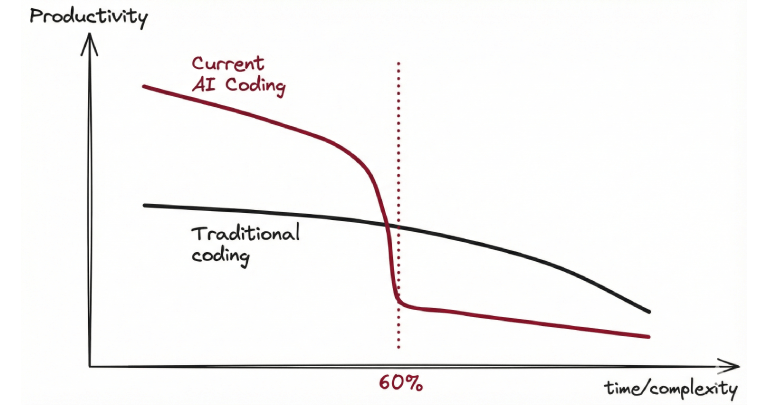
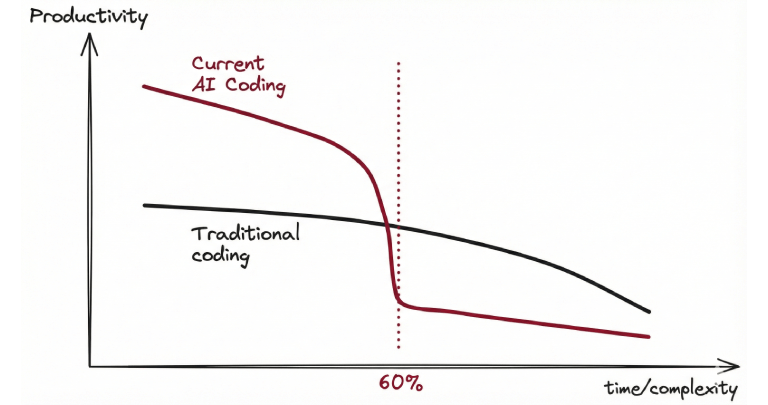
What the “60%” means (and why the
number is symbolic)
The “60%” in this article isn’t
a scientific number carved in stone. It represents a typical barrier: the moment when AI-driven productivity stops increasing
and starts dropping, because the project enters the realm of real complexity.
And research helps explain why that number works
as a metaphor. In a controlled experiment with GitHub Copilot [1], participants with access to the tool completed a programming
task 55.8% faster than the group without AI, often cited as a major productivity gain.
But that kind of gain shows up most strongly in
well-defined tasks, with limited context and a clear beginning, middle, and end. When you switch from a “lab challenge”
to “working in your large repository, full of dependencies and historical decisions,” the picture changes: a METR
study [2] with experienced developers doing real tasks in open-source projects found that, with AI tools, they took 19% longer
to finish the work.
In other words: AI can greatly accelerate the beginning,
but it doesn’t guarantee crossing the final stretch. And that final stretch is exactly what usually separates a prototype
from a product.
Why productivity drops after the midpoint
At first, AI shines because the problem is still
“clean”: building a screen, setting up a CRUD, connecting an endpoint, generating components, suggesting structure,
drafting an API. The context still fits in your head, and often even fits within the tool’s context window.
But as the product grows, layers appear that go
beyond writing code.
Business rules no longer fit inside a prompt. The
exception becomes the rule. A signup flow turns into anti-fraud, reconciliation, audit trails. “Simple login”
turns into SSO, MFA, session control, logs, behavior-based blocking. “The database works” turns into migration,
performance, concurrency, traceability. “Deploy is just pushing it” turns into a pipeline, rollback, feature flags,
observability, and costs.
At that point, AI starts making mistakes in a dangerous
way: it sounds confident, but it doesn’t understand the invisible constraints of your business and ecosystem. You spend
time describing context, correcting assumptions, reviewing code, re-explaining what was already said. The tool still helps,
but the autopilot feeling disappears. And non-programmers tend to get stuck, because they don’t have the repertoire
to diagnose what’s breaking and decide the next step.
This is where projects “stuck at 40%, 50%,
60%” come from. They exist, they run, they feel close to done, but done never arrives.
The trap isn’t using AI; it’s assuming
AI replaces seniority
Maybe the hardest idea to accept is this: today,
the safest way to use code generators isn’t to let the tool do the work. It’s to let the tool accelerate a professional
who knows what they’re doing.
When complexity rises, the bottleneck becomes decision-making.
And decision-making requires experience.
A senior professional sees architecture, risks,
technical debt, integration patterns, security, testability, and operability. They use Lovable, Cursor, Replit (and whatever
else makes sense) as multipliers: to code faster, explore alternatives, validate hypotheses, and reduce mechanical work. But
they don’t outsource understanding. They steer the path.
That explains why the same tool can feel like a
miracle for one project and a frustration for another. The differentiator isn’t AI alone. It’s the combination
of human + AI.
How to break through the 60% barrier in practice
Breaking through isn’t about writing more
prompts. It’s about applying engineering.
It means mapping requirements and edge cases, closing
business rules, designing architecture consistent with the product’s future, ensuring security and compliance, implementing
tests that build confidence to evolve, preparing deploys with traceability and rollback, measuring performance and cost, and
connecting to existing systems without breaking what already works.
AI helps in each of these areas, but it doesn’t
close the project by itself. What closes it is senior people, with method, using AI as an accelerator.
Want to get past 60%? Visionnaire knows how to
unblock it
Visionnaire is a Software and AI Factory with 30
years of experience. That means two important things for you if your project is stuck in the “almost there” phase.
First: we don’t buy the narrative that “AI
will kill software companies.” Reality is simpler and more useful: AI is changing how software is built, and those who
combine modern tools with solid engineering deliver faster and with higher quality.
Second: we also don’t sell the idea that “it’s
AI only.” It isn’t. To cross the 60% barrier, the human in the equation needs to be senior, and needs to work
with process, architecture, and production-grade responsibility.
In practice, Visionnaire takes what has already
been built with tools like Lovable, Cursor, and Replit, understands what’s missing, organizes the path, and finishes.
We turn prototypes into products, MVPs into operations, “it works here” into “it works at scale.”
If you feel your solution is stuck at 40%, 50%,
or 60%, maybe you don’t need to start over. You need to break through, and you don’t have to do it alone. Want
to get past 60%? Contact us.
[1] The Impact of AI on Developer Productivity: Evidence from GitHub Copilot


