

Understand why AI success depends not only on the model, but on the environment built around it
For a long time, the conversation around Artificial Intelligence revolved around an apparently
simple question: what is the best model? Companies compared LLMs (Large Language Models), tested responses, and evaluated
costs, speed, accuracy, and reasoning capability. Then came the era of prompt engineering, in which the great skill seemed
to be knowing how to “talk” to AI. Next, the market began to better understand the value of context: it was not
enough to ask well; it was necessary to provide data, history, business rules, and relevant information.
Now, with the rise of autonomous AI agents, a new discipline is gaining momentum: Harness
Engineering. And it significantly changes the way companies should think about their AI projects. Because, in practice, having
a powerful model is not enough; it is necessary to create the right environment so that this model can act, consult information,
make decisions within safe limits, use tools, learn from feedback, and deliver consistent results. This is where the harness
comes in.
What does “harness” mean in the
context of AI?
The word harness can be translated, depending on the context, as a bridle, a safety belt,
a connection set, or a control mechanism. In all these meanings, there is a central idea: a harness is something that connects,
guides, protects, and allows a force to be used more effectively.
Think of a very strong horse. Without a bridle, reins, and direction, there is power,
but not necessarily control. Also think of a safety belt: it does not move the car, but it creates an essential layer so that
movement can happen with greater protection. Or even an electrical wiring harness in an automotive system, connecting different
parts so the whole system can work.
In AI, the logic is similar. The model is the “brain.” It understands language,
reasons, generates responses, interprets data, and executes tasks when it receives instructions. But, on its own, it does
not necessarily know where to look for information, which tools it can use, which rules it must follow, when it should stop,
how to validate an answer, or how to act when faced with a failure.
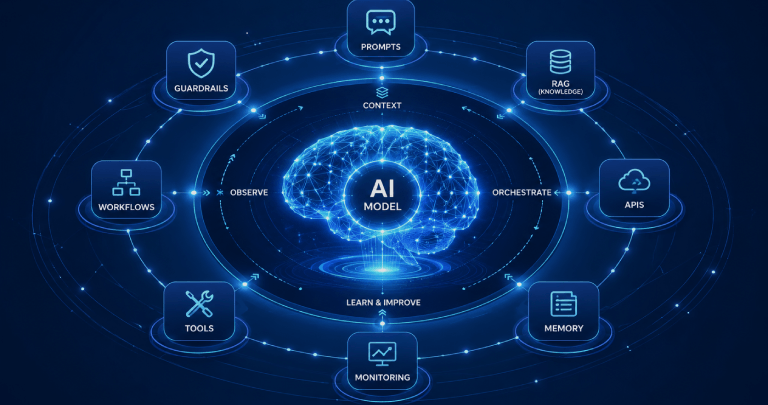
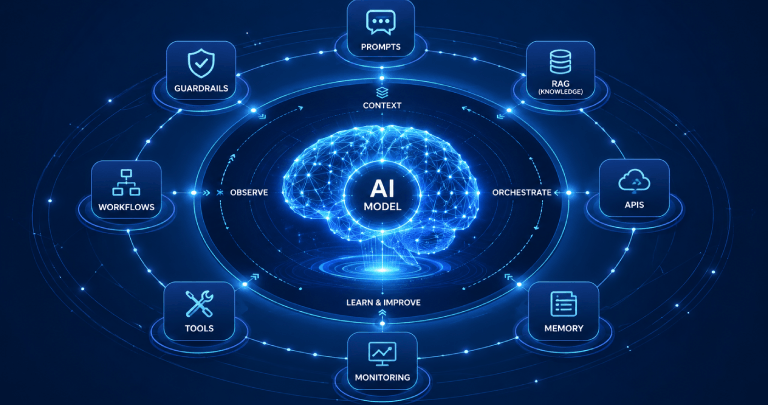
The harness is everything we build around the model to turn it into a useful, reliable
agent aligned with a business objective. In other words: the model thinks, but the harness creates the conditions for it to
work well.
From prompt engineering to harness engineering
Prompt engineering remains important. A good command still makes a difference. But when
we talk about more advanced AI agents, the conversation becomes broader. A company that wants to use AI in customer service,
healthcare, legal, industry, education, finance, or software development does not only need to write a good instruction. It
needs to design a system.
This system can include specialized prompts, knowledge bases, RAG (Retrieval-Augmented
Generation), APIs, memory, permissions, guardrails, integrations with internal systems, audit layers, automatic validations,
logs, monitoring, workflows, and escalation rules for humans. All of this is part of the harness. It is the difference between
an AI that merely “answers something” and an AI that truly executes a process with safety, context, and usefulness.
A simple example: AI for Medicine
Imagine a company developing an AI agent to support healthcare professionals. The model,
by itself, may have general knowledge about health. But that is not enough for serious use. It is necessary to configure a
harness for this specific context.
This harness can include prompts that guide the appropriate medical language, guardrails
to avoid irresponsible diagnoses, integration with clinical protocols, RAG to consult reliable sources, APIs to access authorized
medical record information, rules to indicate when a human physician should be called in, and audit mechanisms to record decisions
and responses.
Notice that the value is not only in the model. It is in the set of elements around it.
AI becomes more useful because it starts operating within an environment designed for the reality of Medicine.
Practical examples of Harness Engineering
In customer service, the harness can connect the AI agent to the CRM (Customer Relationship
Management), purchase history, commercial policy, frequently asked questions knowledge base, and ticketing system. Thus, instead
of providing generic responses, the agent understands the customer’s context, suggests solutions that are compatible
with the company’s rules, and transfers the case to a human agent when necessary.
In the financial sector, the harness can limit sensitive actions, validate data in internal
systems, consult compliance rules, record every interaction, and prevent the agent from providing recommendations outside
the permitted scope. AI gains autonomy, but within a controlled environment.
In industry, an agent can be connected to sensors, maintenance systems, failure histories,
and technical documents. With the right harness, it can help predict problems, guide operators, open support tickets, and
suggest preventive actions, always respecting operational safety rules.
In retail, the harness can integrate inventory, e-commerce platform, browsing behavior,
active campaigns, and discount policies. The result is an AI capable of recommending products, personalizing offers, and supporting
the sales team with much greater precision.
In software development, the harness can give the agent controlled access to the repository,
technical documentation, test environments, coding standards, CI/CD (Continuous Integration and Continuous Delivery) tools,
and automatic validators. Thus, it does not merely write code; it works within a workflow that is closer to real engineering.
The key point: good AI is not just a good model
Many companies still think of AI as a tool choice. They hire a model, plug it into some
process, and expect immediate gains. But reality is usually more complex.
AI can make mistakes due to lack of context. It can access incomplete information. It
can execute an action without validation. It may not know when to ask for help. It can repeat responses, lose track of a long
task, or fail to understand the specific rules of a business.
Harness Engineering exists precisely to reduce these
risks and increase the practical value of AI. It is a discipline that asks: what does this agent need to see, access, remember,
respect, execute, validate, and improve in order to deliver the expected result? When this question is answered well, AI stops
being a generic promise and becomes an applied solution.
The harness as a bridge between AI and business
One of the great advantages of Harness Engineering is bringing technology and strategy
closer together. After all, each company has different processes, data, risks, goals, customers, and restrictions. The harness
allows AI to be adapted to that reality.
Two businesses can use the same model and still obtain completely different results depending
on the environment created around it. One may get generic and unreliable responses. The other may have an integrated, monitored,
secure agent prepared to generate real impact. This difference does not come only from the chosen AI; it comes from the engineering
behind it. That is why Harness Engineering tends to become increasingly relevant for companies that want to move beyond isolated
tests and advance toward AI applications in production.
How Visionnaire can help
Visionnaire is a Software Factory with 30 years of experience in developing digital solutions
for companies across different sectors and of different sizes. This background makes a difference because AI projects do not
exist separately from the reality of corporate systems, processes, and data.
For an AI agent to work well, it is necessary to understand architecture, integration,
security, user experience, business rules, APIs, databases, governance, and operations. This is exactly where the experience
of a Software Factory connects with the new role of an AI Factory.
Visionnaire closely follows the evolution of the Artificial Intelligence field and is prepared to help companies transform models into real, useful solutions that are applicable to the business.
This may involve creating intelligent agents, integrating with existing systems, using
RAG, defining guardrails, developing APIs, automating processes, modernizing digital products, and designing secure environments
for autonomous agents.
More than “putting AI” into an operation, the challenge is to build the right
structure so it can generate value. Click here
to contact us and learn more.
The new question for companies that want to
use AI
The question is no longer only: “which model should we use?” The more important
question becomes: “what environment do we need to create for AI to work well in our business?”
Harness Engineering emerges as the answer to this
new stage. It shows that the quality of an AI solution depends on the model, but also on the context, tools, limits, integrations,
and improvement cycles built around it. Companies that understand this earlier will have an advantage. Because, in the end,
the most competitive AI will not necessarily be the one that simply answers better. It will be the one that works better within
the reality of each business.
And it is in this space, between advanced technology and practical application, that
Visionnaire can help your company create smarter, safer AI solutions prepared to generate results.


