

How AI is redesigning hierarchies, roles, teams, and the very way work gets done
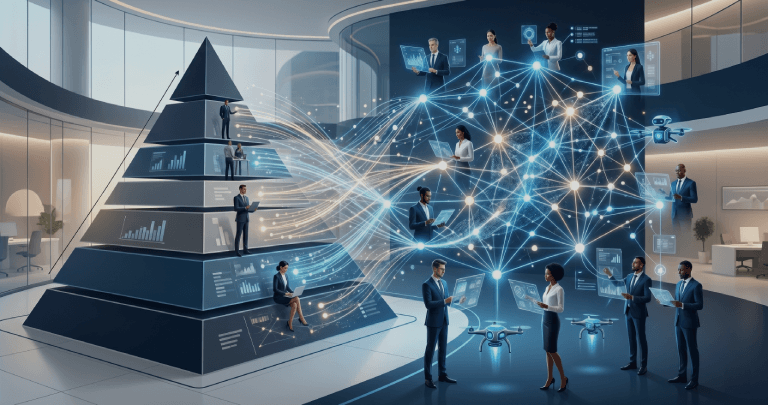
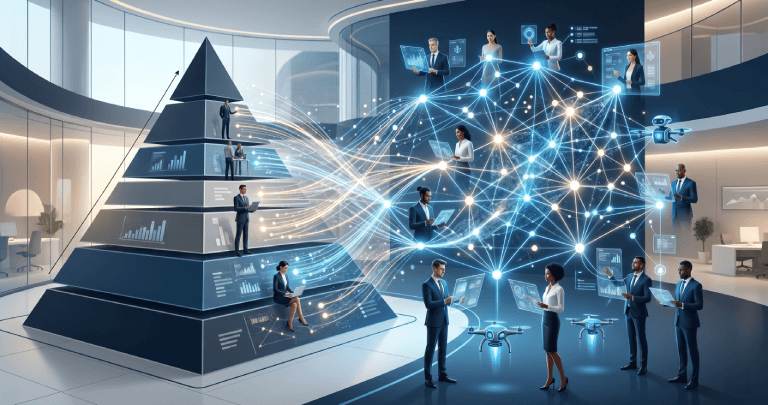
For a long time, organizing a company meant drawing
a pyramid. At the top, leadership. In the middle, managers. At the base, the people executing the work. Each person had a
role, each area protected its territory, and every decision had to move up and down layers before finally becoming action.
This model worked for decades. In some contexts,
it still does. But there is a silent, profound, and increasingly hard-to-ignore shift underway: Artificial Intelligence is
making much of this structure too slow for the current pace of business.
This is not just about using AI to write e-mails,
generate reports, or speed up operational tasks. That is only the first layer. The more relevant transformation is something
else: AI is beginning to question the very logic by which companies have been organized until now.
The question many leaders are already asking is
no longer “how do I put AI inside my company?”, but rather “how should my company be structured now that
AI exists?”.
From farm to factory: the long history of hierarchy
Business administration has always reflected the
spirit of its time. At first, many organizations operated almost like feudal systems. There were owners, properties, centralized
commands, and a very vertical relationship between those who gave orders and those who obeyed. The company was seen as an
extension of the owner’s power.
Then, with wars and the influence of military structures,
business management strongly incorporated the logic of hierarchy. Bosses, subordinates, ranks, discipline, orders, and obedience
began to shape how work was distributed and controlled.
With the Industrial Revolution, the focus changed.
The great obsession became productivity. Producing more, in less time, with less waste and greater predictability. The modern
company inherited from that period its passion for processes, production lines, standardization, and control.
Later, especially throughout the twentieth century,
the role of the manager became professionalized. The manager stopped being merely someone who gave orders and became someone
responsible for planning, coordinating, measuring, developing people, and making better decisions. Peter Drucker, known as
the “father of modern management,” symbolized this shift by treating management as a discipline, a practice, and
a profession.
This evolution was important. It replaced the “whip”
with planning, improvisation with method, and brute authority with the ability to coordinate people around objectives.
But the story did not stop there.
The startup era and the search for speed
Starting in the 2000s, the growth of startups brought
a new vocabulary into companies: agility, MVP, Scrum, sprint, lean startup, Minimum Viable Product, and rapid iteration. The
inspiration came from several sources. From software development, agile methods, and also lean production principles, such
as those popularized by Toyota. The logic was simple and powerful: do not waste time, do not produce more than necessary,
test quickly, learn quickly, and adjust course before the cost of the mistake becomes too high.
During this period, the ideal company stopped being
merely efficient. It needed to be adaptable. Long planning cycles began to look slow. Annual roadmaps started to coexist with
weekly sprints. Large departmental structures began to be challenged by squads, tribes, multifunctional teams, and more flexible
models of collaboration.
Even so, one thing remained: the need for human
coordination at scale. The more the company grew, the more people were hired to align, communicate, convene, prioritize, report,
review, and follow up. Thus emerged a kind of “invisible cost” of collaboration. Not the cost of doing, but the
cost of keeping everyone synchronized.
And this is exactly the point AI is beginning to
attack.
AI does not only change tasks, it changes the
structure
The most advanced discussion about AI in companies
is no longer limited to the automation of activities. The deeper impact lies in reducing the cost of coordination. Every large
company suffers from a similar problem: information gets lost between layers. One person knows what the client asked for.
Another knows what the product allows. Another understands the technical architecture. Another tracks the budget. Another
is responsible for the strategic priority.
For anything to happen, this information needs to
circulate. And the larger the structure, the more meetings, documents, approvals, and handoffs are required. AI enters this
scenario as a kind of intelligence layer capable of connecting data, context, history, decisions, clients, products, and processes.
Instead of relying exclusively on people moving information from one place to another, the company begins to count on systems
capable of organizing, interpreting, and making knowledge available in real time.
This does not eliminate the need for leadership.
But it profoundly changes what leadership means. The leader stops being merely the point through which information passes.
The leader needs to become the point of judgment.
The end of information movers
In many companies, a significant part of corporate
work still consists of moving information. Someone collects data, prepares a presentation, takes it to a meeting, summarizes
it for another area, turns it into minutes, updates a roadmap, communicates it to stakeholders, and repeats the process the
following week.
For a long time, this work was necessary. In complex
companies, someone needed to connect areas, organize conversations, and ensure alignment. But when AI can generate reports,
summarize meetings, cross-reference data, query internal knowledge bases, write specifications, suggest priorities, and automate
workflows, the professional who merely passes information along loses relevance.
That is why there is so much talk about the rise
of “builders.” The new valuable professional is not the one who merely coordinates other people’s work.
It is the one who identifies a problem, uses the available tools, builds a solution, tests it, improves it, and delivers results.
This applies to engineers, designers, product professionals, marketing, operations, sales, and customer service. Increasingly,
the difference will not lie only in the job title, but in the ability to turn context into execution.
Fewer fiefdoms, more fluidity
Traditional boundaries between departments are also
beginning to become less rigid. For decades, companies were organized into clearly defined areas: technology does technology,
product does product, marketing does marketing, sales sells, customer service serves customers, operations operates. This
design still helps organize responsibilities. The problem begins when it becomes a fiefdom.
Departmental fiefdoms create budget disputes, slower
decisions, and an exaggerated defense of territories. The company starts spending energy protecting internal structures instead
of solving real customer problems.
With AI, this logic loses strength. A designer can
prototype a functional interface. A product professional can test an automation. An engineer can validate market hypotheses
with much more autonomy. A marketing team can build internal tools for campaign analysis without waiting weeks in a technology
queue.
Work stops being defined only by “which area
are you from?” and starts being guided by “which problem can you solve?”. This is a huge change. It requires
maturity, because it does not mean chaos. Quite the opposite. The more autonomy there is, the more strategic clarity is needed.
Companies without direction tend to turn freedom into dispersion. Well-oriented companies turn freedom into speed.
The new value of autonomy
Keith Rabois popularized an interesting metaphor
to talk about talent in high-performance companies: barrels and ammunition. Ammunition represents people who can execute very
well when there is a clear direction. They are important professionals, but they depend on someone to point the way.
Barrels are different. They are people with high
autonomy, capable of taking an initiative from zero, gathering resources, overcoming obstacles, making decisions, and carrying
something relevant through to the end.
In the new organizational structure, AI greatly
increases the power of the “barrels.” A professional with good judgment, business mastery, and familiarity with
AI can do alone, or with a very small team, what previously required several layers of support. This changes the company’s
math.
Instead of hiring large teams to compensate for
low autonomy, companies begin to seek greater talent density. Fewer people, more decision-making capacity, greater command
of tools, and more responsibility for results.
This trend may sound uncomfortable. And indeed,
it is. It raises the level of expectations. But it also creates an important opportunity: strong professionals gain more leverage
to produce real impact.
When AI does more, human judgment becomes more
valuable
There is a common mistake in the discussion about
AI: imagining that if technology performs more tasks, the human role automatically diminishes. In practice, something more
sophisticated happens. When building becomes easier, deciding what to build becomes more important. If AI reduces the effort
required to write code, create prototypes, generate analyses, produce content, simulate scenarios, and automate processes,
the bottleneck is no longer just technical execution. The new bottleneck becomes judgment.
What is worth doing? Which problem deserves priority?
Which solution truly improves the customer’s life? Which initiative is aligned with the strategy? Which automation reduces
costs without harming the experience? Which product has scaling potential? Which decision seems efficient in the short term
but dangerous in the long term?
These questions do not disappear with AI. They become
more important. That is why the new company will not be made up only of people who know how to use tools. It will need professionals
with repertoire, business vision, critical thinking, product taste, and the ability to make good decisions in high-speed environments.
AI can accelerate execution. But someone still needs
to know where to accelerate.
Hierarchy does not end, it changes function
It is tempting to say that AI will put an end to
hierarchies. But it may be more accurate to say that it will reduce the need for hierarchies based only on control and information
handoffs. Companies will still need leadership, governance, responsibility, and strategic vision. What tends to disappear
is the excessive management layer that exists only to coordinate what intelligent systems can coordinate better.
The traditional manager, who lives on status reports,
intermediate approvals, and alignment meetings, will have less and less space. In contrast, the importance of the leader who
acts as a mentor, decision-maker, context architect, and talent developer will grow. Not someone distant from execution, but
someone capable of combining strategic direction with practical participation. It is the logic of the “player-coach”
leader: plays alongside the team, guides, corrects course, and helps the team raise its level.
This change also requires a new posture from companies.
It is not enough to buy AI licenses and expect transformation. The organization needs to redesign processes, data, responsibilities,
indicators, and forms of collaboration. Digital maturity stops being a technology project and becomes an organizational capability.
The risk of confusing speed with haste
Every transformation brings exaggerations. With
AI, it will be no different. The search for lean teams and fast decisions can generate extraordinary gains, but it can also
create relevant risks: overload, poorly evaluated decisions, loss of institutional knowledge, fragile automations, governance
problems, and excessive dependence on tools that are still immature. That is why the new organizational structure should not
be built on trends. It needs to be designed intelligently.
Reducing hierarchies does not mean eliminating responsibility.
Automating processes does not mean giving up review. Granting autonomy does not mean abandoning method. Accelerating deliveries
does not mean ignoring security, quality, privacy, or user experience.
The company of the near future will be more fluid,
but no less professional. It will be faster, but no less rigorous. It will be more technological, but it will continue to
depend on people capable of thinking well.
What does this mean for traditional companies?
For many organizations, especially those that were
not born digital, this transition may seem distant. But it has already begun. Companies across all sectors are being pressured
to reduce costs, respond to the market faster, personalize experiences, integrate data, and launch digital solutions more
frequently. In this context, heavy structures become a competitive problem.
The good news is that it is not necessary to become
a startup overnight. The smartest path usually begins with practical questions. Which internal processes depend on manual
information handoffs? Which decisions take too long because they pass through too many layers? Which areas could use AI to
reduce repetitive work? Which professionals have the potential to become more autonomous with the right tools? Which products,
systems, or integrations need to be modernized to support a more intelligent operation?
These questions help turn AI into strategy, and
not just an experiment.
The right technology for a more intelligent company
The new organizational structure will not be born
merely from speeches about innovation. It will require well-built systems, data, automations, and applications. This is where
technology stops being support and becomes business architecture.
Companies that want to operate more intelligently
need to integrate information, automate workflows, create digital products, modernize legacy systems, and develop AI solutions
connected to the reality of the operation. It is not enough to have isolated tools. It is necessary to build a technological
foundation capable of delivering speed without losing control.
For a Software and AI Factory like Visionnaire,
this movement is especially relevant. With 30 years of experience in developing digital solutions, the company is following
a shift that goes far beyond the adoption of new tools: it is about preparing organizations to work in a different way. Leaner.
More integrated. More data-driven. More capable of turning knowledge into action.
The company of the future will be smaller, smarter,
and more demanding
The new organizational structure of companies will
not be defined only by beautiful org charts or management methodologies. It will be defined by the ability to combine AI,
human autonomy, and strategic clarity.
The most competitive companies will be those capable
of reducing bureaucracy, eliminating fiefdoms, developing more builder-oriented professionals, automating repetitive work,
and preserving what remains deeply human: judgment, creativity, empathy, product vision, and responsibility.
Traditional hierarchy was born to organize work
in a world of slow information. AI emerges in a world of abundant information, fast decisions, and constant change. In this
new scenario, those who can turn intelligence into execution will win.
And this transformation begins now.


