

Smarter, more collaborative agents are beginning to take on complete tasks within companies
Until just a few months ago, talking about Artificial
Intelligence agents already seemed to represent the next major technological transformation. They were moving beyond simply
answering questions to planning actions, using tools, and carrying out tasks with a certain degree of autonomy. But the evolution
did not stop there.
A new wave is beginning to show that so-called agentic
AI is moving to another level. Agents are becoming more persistent, more autonomous, able to maintain context for longer periods,
learn ways of working, collaborate with other agents and, most importantly, take a task from start to finish.
The difference may seem subtle, but it completely
changes what companies can do with Artificial Intelligence. Before, the question was: “How can we automate this task?”
Now, it is becoming: “Can we simply delegate this work to an AI?”
From automation
to delegation
Automation is nothing new. Companies have used systems
for decades to send messages, process information, generate reports, move data between applications, and execute pre-programmed
routines.
Generative AI expanded this universe by enabling
machines to handle language, documents, images, and unstructured information more effectively. Then came agents, capable of
combining reasoning with tools and executing sequences of actions. Now we are reaching a new stage.
Imagine an agent responsible for monitoring an inbox.
In a conventional automation, it could identify new messages and classify them. In a more advanced approach, it could summarize
the content and suggest a reply.
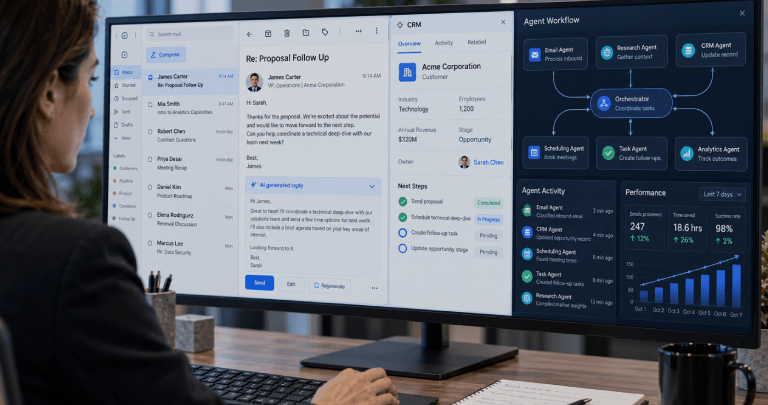
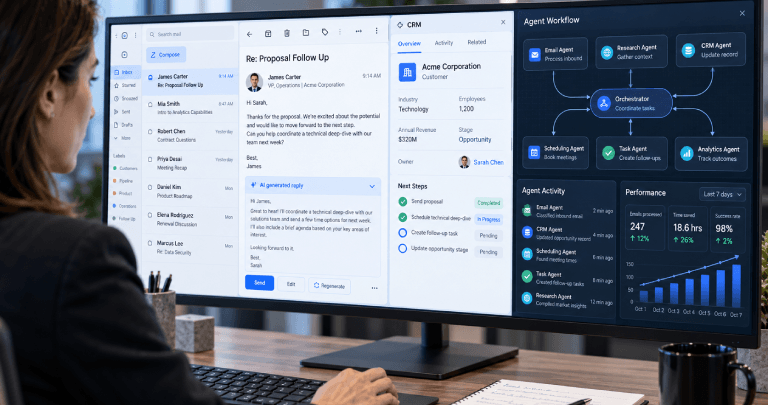
A new-generation agent can go further: read the
e-mail, understand the previous context of that conversation, consult information in other systems, prepare a response, send
it when authorized, update the CRM, create a follow-up task, and later check whether there has been a reply.
What matters is no longer an isolated action. It
is completing the work. This logic brings agents ever closer to the way we delegate activities to a person. Instead of describing
every click, every system, and every intermediate step, the user defines an objective and expects a result.
Grok Bot
and the idea of a digital employee
The recently launched Grok Bot is a very clear example
of this shift. Introduced in August 2026, it is described as a team of AI agents that are permanently available. Each bot
has its own computer in the cloud, can access applications and websites used by the user, maintain context, and continue working
even after the person closes their computer.
The concept helps illustrate the scale of the change.
We are not simply talking about opening a chatbot and asking how to perform a certain task. The goal is to hand the task over
to the bot.
According to SpaceXAI itself, these agents can carry
out end-to-end work in areas such as sales, operations, marketing, support, and software development. They can also operate
in parallel and collaborate with one another, sharing context, dividing responsibilities, and involving the user only when
a human decision is truly necessary.
In other words, the user no longer has to act as
the intermediary between multiple AIs. This is especially important. When we need to copy a response from one agent to another,
explain the context again, or manually coordinate each step, we remain an essential part of the execution flow. When the agents
themselves exchange information and distribute tasks among one another, we begin to talk about genuinely collaborative systems.
OpenClaw
also moves to the next level
OpenClaw’s recent evolution shows a similar
movement. Visionnaire has already discussed
how the platform works as a layer capable of connecting agents, models, channels, and different tools. This new evolution
deepens that proposal and brings OpenClaw even closer to a complete working environment for agents.
Among the changes presented by the team itself are
a major overhaul of the control interface, shared sessions, collaborative environments, the ability to monitor the work of
different agents, dashboards created by the agents themselves, and mechanisms for transferring a work session between team
members.
One example presented by the team helps illustrate
this future. Developers can work in the same shared environment, view sessions run by colleagues, and even take over work
previously started by another person or agent. In one account, a task left running overnight was picked up by another team
member and completed before the original professional returned to work.
The concept of collaboration is therefore beginning
to move beyond the boundary between humans and machines. We no longer have only humans working with agents. We have humans
and agents working in the same environment, sharing context, activities, and results.
Agents
that learn how to work
Another important advancement lies in the ability
to transform experience into reusable knowledge. In the update presented by OpenClaw, a learning mechanism can observe usage
patterns and automatically create skills, or procedural capabilities, based on tasks performed repeatedly. The agent begins
to record not only information that should be remembered, but also a way of doing something.
The distinction matters. Memory answers something
like: “What happened last time?”
This does not eliminate the need for supervision.
On the contrary, the more autonomy an agent receives, the more important permissions, auditing, validations, and clear boundaries
become. But it profoundly changes the scale at which operational knowledge can be transformed into software.
What about
Windows?
Another important change for the wider adoption
of this type of technology is the reduction of barriers to entry. OpenClaw’s expansion to Windows is no longer merely
a distant possibility. The project currently has alpha versions of OpenClaw Windows Hub, including installers for x64 and
ARM64 architectures. This means that a native experience on Microsoft’s operating system is already under development
and distribution, although it should still be treated as an implementation that is maturing rather than as a fully stabilized
final experience.
This matters because agentic technologies stop being
relevant only to developers or enthusiasts when they begin reaching the computers used every day inside companies.
The material presented by the OpenClaw team itself
emphasizes a simpler installation experience, with automatic discovery of existing tools and an onboarding process designed
to reduce the need for complex technical configurations. The lower the barrier to getting an agent up and running, the faster
adoption is likely to be.
From an
intelligent agent to an intelligent system
There is another important piece in this puzzle:
Graph
Engineering. Recently, we showed on the Visionnaire blog that the evolution of agents is beginning to shift attention
from the intelligence of a single AI to the intelligence of the system as a whole.
Instead of expecting one agent to understand the
problem, execute every step, validate its work, retain all the context, and make every decision, different agents can be organized
into structures in which each component has a role and the work flows between them. This is precisely where the new generation
of agents becomes even more interesting.
The better individual agents become, the greater
the potential of systems composed of several of them. One agent can research. Another can validate the information. A third
can produce a specific deliverable. Another can check quality or security. Depending on the result, the flow follows different
paths.
The real leap does not necessarily lie in the existence
of an extremely powerful AI working alone. It may lie in the ability to organize multiple intelligences around a goal. The
logic is similar to that of a company: an organization’s performance does not depend only on the competence of each
employee, but on how people, processes, responsibilities, and information are coordinated. Something similar happens with
agents.
A new kind
of enterprise software
This scenario is also beginning to reshape the very
definition of software. For decades, we have used applications by navigating menus, forms, and screens. When we wanted to
accomplish something, we needed to learn how a particular system had been designed.
AI has begun to reverse this relationship. Instead
of the user learning how to operate the software, the agent can learn how to use different software applications on the user’s
behalf. This is a fundamental shift. Enterprise systems stop being merely tools used by people and also become environments
used directly by agents.
A CRM, for example, no longer has to depend exclusively
on a salesperson opening a particular screen to update an opportunity. An agent can understand a meeting, interpret a subsequent
e-mail, record the information in the CRM, prepare the next contact, and monitor the progress of that deal. The same reasoning
can be applied to Human Resources, support, procurement, operations, technology, finance, and countless other areas.
This is one of the reasons why the evolution of
agents deserves special attention from companies. It is not just about doing the same tasks faster. It is about rethinking
who, or what, will execute each part of the work.
So, have
we reached AGI?
With agents becoming increasingly autonomous, capable
of using computers, learning procedures, collaborating, and working for long periods, an inevitable question reappears: have
we already reached Artificial General Intelligence (AGI)?
The issue begins with the very definition of AGI.
There is no universally accepted benchmark. OpenAI, for example, has historically defined AGI as highly autonomous systems
capable of outperforming humans at most economically valuable work. Researchers at Google DeepMind, meanwhile, have proposed
assessing progress toward AGI through dimensions such as breadth of capabilities, performance, and autonomy, treating that
evolution more as a series of progressive levels than as a single boundary crossed on a particular day.
For this reason, the fact that an agent can work
independently for hours or execute a complex sequence of actions is not, by itself, enough to prove that AGI has arrived.
Autonomy is not necessarily generality. A system can be extraordinarily competent at performing certain tasks while still
having important limitations in others.
What is becoming harder to ignore, however, is how
much the distance between an “AI assistant” and a “digital worker” has narrowed. Perhaps this is the
most relevant point for companies right now. Waiting for global consensus on the arrival of AGI may be a fascinating debate,
but companies do not need to wait for that consensus to recognize that today’s agents are already changing the way work
can be organized.
Companies
need to think beyond the chatbot
The first phase of generative AI led many organizations
to place chatbots within their processes. The next phase will probably demand much more. Companies will need to decide which
tasks can be delegated, which systems each agent may access, when an action may happen automatically, which decisions require
human approval, and how everything that happened can be audited. They will also need to design how these agents communicate.
This is where software architecture, integration,
security, context, governance, and Graph Engineering stop being exclusively technical topics and become part of business strategy.
The new wave of AI agents is not simply a better
generation of chatbots. We are moving from systems that respond to systems that act. From tools that wait for commands to
agents that pursue objectives. From isolated AI to teams of intelligences working together. And, potentially, from software
operated exclusively by people to organizations in which humans and digital agents will increasingly share the work.
For a Software and AI Factory like Visionnaire,
with 30 years of experience building digital solutions, this transformation opens a new frontier. The challenge for companies
will not simply be choosing the best Artificial Intelligence model, but designing systems in which agents, software, data,
and people can work together securely, efficiently, and with clear objectives.
The age of agents had already begun. Now, they are
learning how to truly work.


