

Understand how visibility into application behavior helps reduce failures, speed up fixes, and protect your business
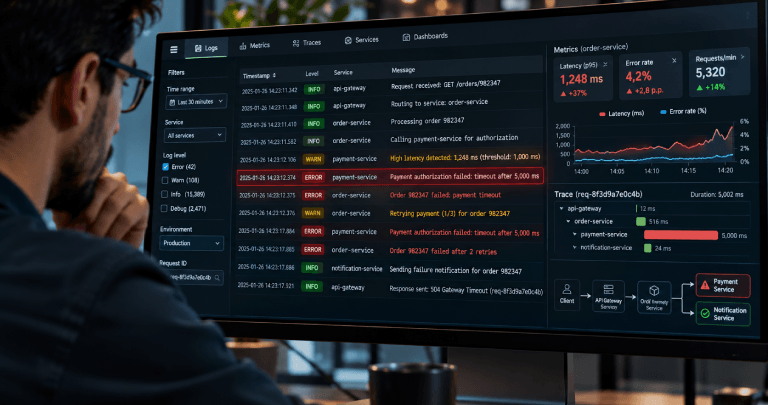
Imagine your company has a system that works perfectly
during testing but begins to slow down when hundreds of users access it at the same time. The servers remain up, the indicators
appear normal, and no obvious errors show up in the logs. Even so, customers cannot complete their transactions. There is
a problem, but no one knows exactly where it is.
This scenario highlights one of the biggest challenges
in modern software development: building systems that work is not enough. You also need to understand how they behave, especially
when something unexpected happens.
This is precisely where Observability becomes important.
More than a technical practice, it represents an evolution in how companies develop, operate, and improve their applications.
What is Observability?
Simply put, Observability is the ability to understand
the internal state of a system from the information it produces while running. This makes it possible to investigate issues,
identify unexpected behavior, and assess the performance of complex applications.
The concept originates in control theory, a field
of engineering that studies the behavior of dynamic systems. In information technology, it gained prominence primarily with
the rise of cloud computing, microservices, and distributed systems.
Today, even a simple transaction may involve multiple
APIs, databases, external services, and components spread across different environments. When something fails along the way,
pinpointing its source can become a complex investigation.
Observability provides the information needed to
understand how these applications operate, even in situations that were not anticipated during development.
The three pillars
of Observability
Traditionally, Observability is built on three fundamental
types of telemetry data: Metrics, Logs, and Traces. Each offers a different perspective on system behavior.
Metrics are numerical measurements that reflect
application performance over time. They include data such as CPU usage, memory consumption, request volume, latency, and error
rates.
Logs record events generated during software execution.
They may capture authentication failures, completed operations, exceptions, and specific errors, generally with information
that helps explain their context.
Traces show the path a request or transaction takes
through a system. They are particularly important in distributed architectures, where a single operation may pass through
multiple services.
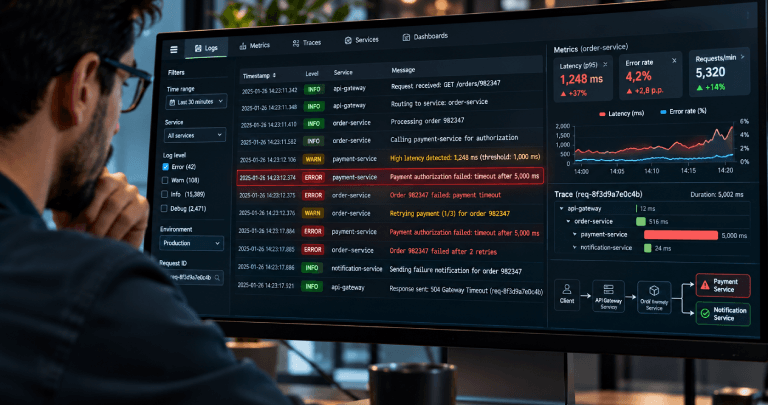
Consider, for example, an e-commerce platform where
some customers cannot complete their purchases. Metrics reveal an increase in the error rate. Traces show that the failures
are concentrated in communication with the payment service. Logs provide details about the problems recorded during those
attempts. Together, these data help reconstruct the incident and accelerate its resolution.
However, Observability is not limited to these three
pillars. Information about changes to the environment, dependencies, and user experience can also enrich the analysis. The
real value lies in connecting these data and turning them into useful knowledge.
Is Observability
just a new name for old practices?
It is a fair question. After all, developers have
used logs for decades. Tracking metrics is nothing new, nor are application monitoring tools. So, is Observability simply
a new label for activities that have always been part of software development?
The answer is: not exactly. The practices that underpin
Observability are not new. What makes the difference is how this information is integrated, contextualized, and used to investigate
system behavior.
Logging, for example, generates data that contribute
to Observability. But having thousands of log entries does not automatically make a system observable. If information is scattered,
lacks context, or cannot be linked to a specific request, tracking down the source of a problem remains difficult.
Think of it as a jigsaw puzzle. Having all the pieces
matters, but that does not mean you can see the full picture. Likewise, Observability does not reinvent event logging or metric
collection. It broadens the purpose of these practices, allowing teams to ask new questions about a system and find answers
in the available data.
Are Observability
and Monitoring the same thing?
The two concepts are closely related, but they are
not synonymous. Monitoring involves tracking predefined indicators and conditions. It typically relies on dashboards and alerts
configured to detect specific situations, such as rising error rates or excessive resource consumption.
Observability enables broader investigation, helping
teams understand unexpected behavior even when no alert has been configured for a particular situation.
One simple way to distinguish the two is to consider
the questions they help answer. Monitoring seeks to identify whether something is wrong. Observability provides the information
needed to investigate why it is happening.
This does not mean Monitoring cannot contribute
to root-cause analysis. In practice, the two approaches complement each other and are part of an effective software reliability
strategy.
Why is Observability
important in software development?
Growing system complexity has changed the challenges
faced by technology teams. Microservices architectures, cloud applications, and API integrations offer scalability and flexibility,
but they also increase dependencies and potential points of failure.
Without adequate information, developers may spend
hours trying to reproduce errors or identify which component is disrupting an operation. Observability reduces this difficulty,
enabling more accurate diagnoses and helping shorten the time needed to identify and resolve incidents. Its benefits, however,
go beyond troubleshooting.
By incorporating Observability from the earliest
stages of a project, teams can track the impact of new features, assess performance after updates, and identify opportunities
for optimization. This practice also strengthens collaboration between development and operations, aligning with core principles
of DevOps and Site Reliability Engineering (SRE). The result is a more data-driven development process, in which technical
decisions can be based on how applications actually behave.
Observability
is also a business issue
Although Observability is often discussed in technical
terms, it has direct implications for business results. Consider a payment platform, an enterprise management system, or an
app used by thousands of consumers. Slowness, downtime, and recurring failures can lead to lost revenue, dissatisfied customers,
higher operating costs, and reputational damage.
In this context, understanding application performance
also means protecting business continuity. An Observability strategy makes it possible to connect technical indicators with
tangible outcomes, such as response times for critical operations, service availability, and successful transactions. It also
helps teams track Service Level Objectives (SLOs), which set measurable reliability targets based on the experience users
expect.
With this information, managers can prioritize fixes
and investments based on the impact of problems on operations and customers, rather than relying only on isolated infrastructure
indicators.
How can you
implement Observability effectively?
Building observable systems does not simply mean
installing a tool and collecting every available data point. The first step is to identify which operations are critical to
the business, which indicators need to be tracked, and what information will be required to investigate potential failures.
From there, applications must be instrumented to
produce structured, correlatable data, reliability indicators need to be established, and this information must be integrated
into development and operations processes.
Initiatives such as OpenTelemetry play an important
role in this process. The open-source project provides tools, APIs, and standards for generating, collecting, processing,
and exporting telemetry data, making it easier to use across technologies and platforms.
Another key consideration is balancing visibility
with efficiency. Collecting excessive amounts of information can increase storage and processing costs without necessarily
improving diagnostic capabilities.
Security and privacy are also essential, ensuring
that logs and other records do not expose credentials, personal information, or sensitive data. A sound Observability strategy
therefore depends less on the volume of data collected and more on the quality of information available for analysis.
Artificial Intelligence
brings new challenges for Observability
The growth of Artificial Intelligence adds another
dimension to this topic. In AI agent-based systems, a single operation may involve language models, knowledge base queries,
tool calls, and multiple execution steps. In such cases, traditional logs may not provide enough information to understand
application behavior.
It is also necessary to track the prompts used,
the context provided, the tools invoked, the sequence of actions, token consumption, costs, latency, and results.
This need is connected to the concept of Harness Engineering, which involves building environments, tools, and control mechanisms to make AI applications more reliable.
Observability also supports the security and governance
of these systems by making it possible to identify unexpected behavior, investigate failures, and maintain auditable records
while respecting privacy and confidentiality requirements.
Despite these particularities, the underlying principle
remains the same: understanding how complex systems behave through the information they produce. AI did not create the need
for Observability. It simply made its importance even more apparent.
The future of
software development requires visibility
For a long time, much of software engineering focused
on building features, fixing defects, and releasing applications to users. These activities remain essential, but they are
no longer sufficient to meet the demands of increasingly distributed systems that are critical to business operations.
Today, developing high-quality software also means
building applications that can be diagnosed, understood, and continuously improved. Observability is therefore moving beyond
an operational concern to become a strategic capability for companies that rely on technology to grow, innovate, and compete.
At Visionnaire, a Software and AI Factory with 30
years of experience, we believe that the quality of a technology solution lies not only in the features it delivers, but also
in its reliability, security, performance, and ability to evolve.
Is your company struggling to maintain complex systems,
identify failures, or ensure application stability? Contact Visionnaire and discover how to build more robust, scalable software solutions aligned with your business needs.


