

OpenClaw gains ground as an execution layer, while cloud, Windows, and visual AI lower barriers for agents
For a while, talking
to an Artificial Intelligence seemed revolutionary enough. You asked a question, received an answer and, in some cases, copied
that answer into another system to finally get something done. But AI agents are changing that logic.
Instead of merely responding,
they can browse, access tools, work with files, run scheduled tasks, use different models, remember previous contexts, and
operate across multiple channels. And as this market matures, one technology in particular is appearing more and more throughout
this ecosystem: OpenClaw.
The interest is no
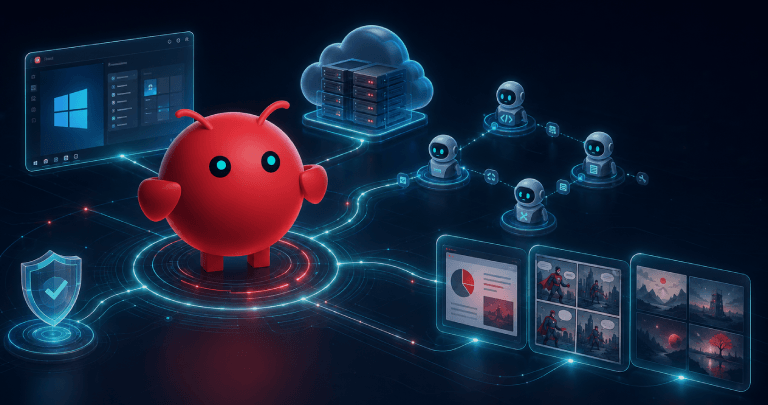
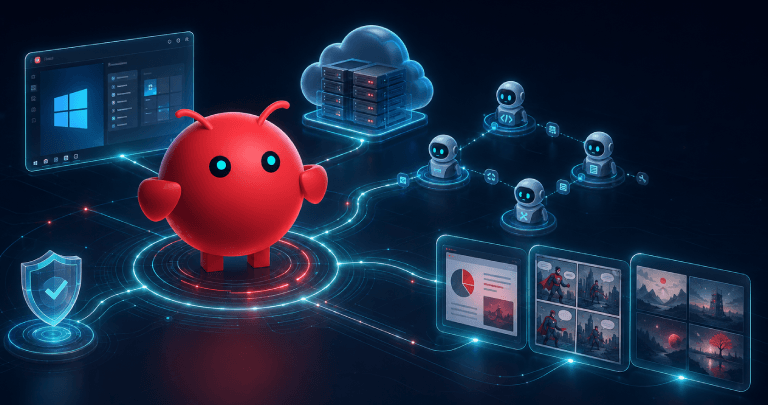
coincidence. OpenClaw works as a self-hosted gateway for AI agents, connecting models and agents to channels such as Slack,
Telegram, WhatsApp, Microsoft Teams, and others. Its architecture includes tools, skills, memory, sessions, and multi-agent
routing. In practice, it provides a layer that helps transform AI from a simple conversational interface into something much
closer to a persistent digital worker. And the barriers to getting all of this up and running are falling quickly.
Why is OpenClaw
attracting so much attention?
There is a huge difference
between an AI that can tell you how to do something and an AI that is prepared to actually do it. Imagine asking an assistant
to periodically monitor specific information, access systems, consult files, use a particular tool, and return only when there
is something important. Or maintaining different specialized agents, each responsible for part of the process. This is exactly
the territory of agents.
OpenClaw provides important
components for this model. Its skills work as reusable instructions that teach agents how to execute specific workflows. Tools
expand what they can do. Plugins add new capabilities, providers, channels, and integrations. There are also mechanisms for
memory, scheduled automations, and multiple agents.
This addresses a pain
point that is becoming increasingly evident in companies. It is not enough to have access to an increasingly intelligent AI
model. It must be connected to the environment where the work actually happens. It is in this space between intelligence and
execution that platforms such as OpenClaw become relevant.
OpenClaw on Windows:
a major barrier is falling
Another relevant sign
is OpenClaw’s progress within the Windows ecosystem. In June 2026, Microsoft announced that OpenClaw runs natively on
Windows using Microsoft Execution Containers (MXC), a containment layer designed to control what agents can access during
execution. OpenClaw also provides Windows Hub, a native companion application for Windows 10 20H2+ and Windows 11.
It is not merely a
matter of compatibility. When a technology no longer requires configurations that are unfamiliar to a large share of users
and becomes better integrated with the desktop environment that companies and professionals already use, the cost of experimentation
falls. And that could provide a significant boost to agent adoption.
Instead of thinking
of agents as something restricted to Linux servers, terminals, or experimental environments, it becomes more natural to imagine
these systems coexisting with everyday applications and workflows. This movement also reflects a shift in perception: persistent
agents are leaving the lab and entering the real work environment.
The cloud is making
OpenClaw much more accessible
Running an agent continuously
involves more than installing a package. You need to manage infrastructure, availability, updates, storage, isolation, credentials,
network access, backups, and security. For someone who simply wants to experiment with an automation, this list may represent
more effort than the expected benefit. This is precisely the friction that a new generation of managed services is trying
to eliminate.
MyClaw, for example,
offers managed deployment of OpenClaw and other agents, with setup in just a few steps, continuous operation, automatic updates,
and backups. According to the platform itself, OpenClaw instances run in isolated environments with encrypted access.
Agent 37 follows a
similar approach. The platform hosts OpenClaw and Hermes Agent in isolated containers, manages runtime updates, and even allows
agents to be provisioned through an API or offered through white-label models.
KiloClaw, meanwhile,
offers managed OpenClaw in Firecracker microVMs and publishes an independent white paper on its security architecture. The
platform also offers a free trial period, lowering the barrier for those who want to experiment before committing to their
own infrastructure. The result is an important shift: testing a persistent agent no longer has to begin with manually configuring
a server.
As happened with other
infrastructure technologies, the trend is for much of the complexity to be encapsulated. The user chooses the agent. Chooses
the model. Connects the required services. And starts testing the business workflow.
Easy to install
does not mean easy to govern
There is, however,
a fundamental distinction here. One thing is to make an agent easy to deploy. Another is to make it safe to operate within
a company. Microsoft has already drawn attention to this issue when analyzing self-hosted agent runtimes such as OpenClaw.
Agents of this kind can be given access to files, credentials, browsers, corporate systems, and tools capable of taking real
actions. The greater the autonomy, the greater the care required around identity, isolation, and permissions. That is precisely
why the evolution of containment technologies is so relevant.
The goal should not
simply be to create an agent capable of doing everything. The ideal is to create an agent capable of doing exactly what it
is supposed to do, using only the necessary resources and operating within known limits. For companies, this means that the
conversation about AI agents needs to involve architecture, security, observability, access control, human approval, and governance
from the start.
Ease of deployment
increases the speed of experimentation. But good architecture continues to be what separates an interesting proof of concept
from a reliable enterprise solution.
Hermes shows that
the ecosystem is getting bigger
OpenClaw is not growing
in isolation either. Hermes Agent, from Nous Research, is another example of the new generation of persistent agents. Open-source
and distributed under the MIT license, it combines persistent memory, skill creation, and communication across different platforms.
There are even specific tools for importing OpenClaw configurations into Hermes.
This reveals something
perhaps more important than any individual product: an ecosystem of interoperable agents is emerging, with tools, skills,
runtimes, and hosting services becoming increasingly interconnected. The value is likely to shift from the question “which
chatbot should I use?” to much more interesting questions: “Which agents does my company need?”, “Which
systems should they have access to?”, “Which tasks can they perform autonomously?”, “When should they
request human approval?”, “Which model should be used for each task?”. This represents a considerable shift
in how we think about AI.
As agents learn
to act, visual AI learns to produce
This evolution is not
happening only in automation. Generative AI is also becoming significantly more capable in visual production. Claude Design,
launched by Anthropic in 2026, is a good example. The tool was created to produce designs, prototypes, presentations, and
visual materials through a conversation with Claude. It is also possible to provide documents, existing presentations, and
design systems to guide the visual identity of the output.
At the same time, image-generation
models continue to make progress on problems that, until recently, were quite obvious. Text inside images, for example, was
practically synonymous with scrambled letters and meaningless words. Character consistency was also difficult: a protagonist
created in the first image could appear with a different face, clothing, or overall look a few scenes later.
Newer models are already
being developed explicitly to improve these capabilities. Google’s Nano Banana 2, for example, highlights more accurate
text rendering and greater consistency of characters and objects. Google itself demonstrates the model producing visual stories
across multiple scenes while keeping the same characters. This opens possibilities that go far beyond “generating a
beautiful image.”
Complete presentations,
campaign materials, storyboards, illustrated stories, comics, conceptual manga, prototypes, social media assets, and personalized
content can increasingly be created through much more automated workflows. And this is where agents and visual generation
begin to converge.
The next step is
to bring intelligence, tools, and production together
Imagine an agent receiving
a brief, researching information, organizing the data, developing the narrative, writing the copy, preparing a set of slides,
and activating visual tools to complement the presentation. It could then send the material for human review, receive corrections,
and generate a new version.
Separately, virtually
all of these capabilities already exist. What is happening now is the creation of connections between them. That is why the
growth of technologies such as OpenClaw matters. They do not necessarily need to be the model that writes best, the model
that creates the best image, or the application that makes the best presentation. Their role can be different: orchestrating
capabilities so that AI can complete a job from end to end. This may be one of the most important transformations in the current
phase of Artificial Intelligence.
Does your company
need OpenClaw?
Not necessarily. And
that may be the wrong question. A more useful question is to identify which processes in your company could already be performed,
partially or entirely, by AI agents. Where are the repetitive activities? Where do professionals spend time transferring information
between systems? Which tasks depend on queries, data consolidation, document generation, or periodic monitoring? Where could
an AI perform part of the process and request human intervention only at the moments when it is truly necessary? The technology
decision comes after that.
OpenClaw may be one
option. Hermes may be another. In certain scenarios, a completely different architecture will make more sense. Technology
should come after the problem.
AI agents are entering
a new phase
Chatbots made AI talk.
Agents are making AI work. OpenClaw, Hermes, managed hosting platforms, new security layers in Windows, and tools such as
Claude Design are different signs of the same transformation: we are moving from isolated models to AI systems capable of
using tools and effectively participating in processes.
For companies, the
opportunity is significant. So is the need for care. The differentiator will not simply be installing the most talked-about
tool of the moment, but combining AI, software engineering, integration, data, security, and business knowledge to build agents
that solve real problems.
This is precisely where
the experience of a Software and AI Factory makes a difference. With 30 years of experience developing technology solutions,
Visionnaire follows this evolution not only because of the potential of new models, but because of what truly matters to companies:
turning technology into reliable, integrated software capable of delivering results. Because the next AI revolution
may not happen when it answers better. It will happen when it knows what to do after the answer.


