

Humanoids draw attention, but the real revolution is in intelligent machines built for each task
When we think of robots,
one image comes to mind almost automatically: a machine with a head, arms, legs, and movements that imitate human beings.
Decades of movies, books, and technological demonstrations have built this association. And recent advances in humanoid robots
seem to reinforce it.
But perhaps this is
precisely one of the ideas about robotics that we will need to leave behind.
This is where the evolution
of Artificial Intelligence meets industrial robotics. AI is beginning to move beyond computers, smartphones, and digital interfaces.
It is gaining sensors, motors, arms, wheels, and other ways to act directly on the physical world. We are entering the era
of Robotic AI.
Not every robot needs to be humanoid
The reality of factories
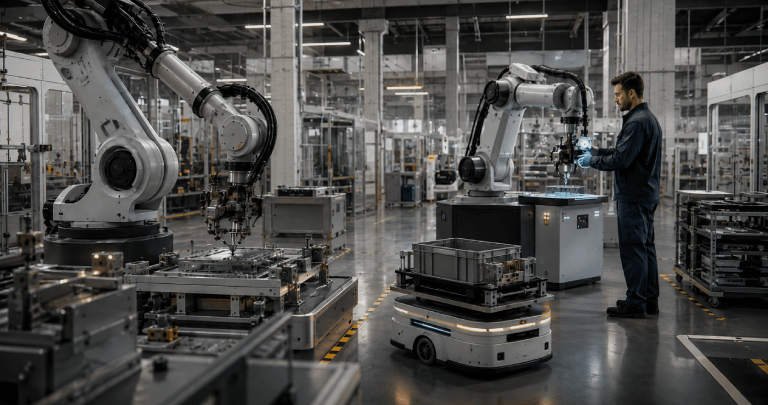
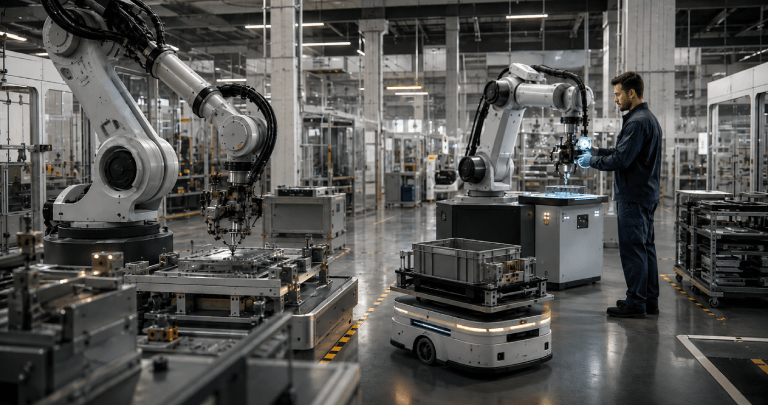
itself already contradicts the idea that a robot needs to look human. The International
Federation of Robotics (IFR) classifies industrial robots into different mechanical structures, including Articulated,
Cartesian, SCARA, Parallel or Delta, Cylindrical, and other configurations. Each architecture exists because certain geometries
are more efficient for certain tasks.
A robotic arm can perform
welding with tremendous precision. A Delta robot can sort and position objects at extremely high speed. An autonomous mobile
robot can cross a warehouse while transporting materials. Cobots can share
workspaces with people. Machines on wheels, tracks, or four legs can reach places where a humanoid would be expensive, complex,
or simply unnecessary. In industrial robotics, therefore, form tends to follow function.
This does not mean
that humanoid robots are merely a spectacle. There is an important advantage to building a machine with dimensions and movements
similar to ours: virtually the entire physical world was designed for human beings. Stairs, corridors, doors, tools, workbenches,
vehicles, and equipment follow our proportions. A robot capable of using these environments without major adaptations can,
in theory, be extremely versatile.
This is where the humanoid
finds its main promise: not necessarily performing a single task better than a specialized machine, but being able to perform
many different tasks in environments originally built for people.
The robot “Olympics” are more important than they seem
One of the most curious
manifestations of this evolution is taking place outside factories.
In 2026, the competition
grew significantly. The second edition brought together more than 2,000 humanoid robots and hundreds of teams once again coming
from different countries, turning the event into a kind of large public laboratory for the evolution of robotics.
At first glance, it
may look like nothing more than a technological version of the Olympics. Robots running, playing soccer, or trying to keep
their balance certainly make for impressive videos. But the real value lies in what happens behind
those images.
To run, a robot needs
to interpret its environment, control dozens of movements simultaneously, and continuously correct its balance. To play soccer,
it needs to identify the ball, locate other participants, plan movements, and react to situations that were not completely
anticipated. If it falls, it needs to understand its position and figure out how to get back up. These are challenges that
also appear in industry. An intelligent machine needs to perceive, decide, and act. And the less predictable the environment,
the more important this combination becomes.
When AI leaves the screen
During the first major
wave of generative AI, most attention was focused on the digital world. Models began writing text, generating images, programming
software, analyzing documents, and talking to users. Then came agents capable of executing increasingly complex workflows.
Now a new frontier is opening up: bringing this intelligence into the physical world.
This is the concept
known as Physical AI, Embodied
AI, or Physical Artificial Intelligence. Artificial Intelligence moves beyond merely interpreting information and begins
controlling systems capable of interacting directly with real-world environments. This transition depends on the combination
of several technologies: AI models, computer vision, sensors, real-time processing, simulation, motors, control systems, and
specialized hardware.
In March 2026, for
example, NVIDIA introduced new technologies focused on Physical AI and announced work with industrial, surgical, and humanoid
robotics companies to bring these systems into real-world production applications.
The difference matters.
An AI system capable of explaining how to organize a warehouse generates knowledge. An AI system connected to mobile robots
capable of physically reorganizing that warehouse turns knowledge into action. AI can identify a defective part in an image.
Connected to cameras, sensors, and robotic systems, it can find that part on the production line and remove it automatically.
Intelligence stops being merely a recommendation. It becomes part of the operation.
Industry is already full of robots
This transformation
is not starting from scratch either. According to the IFR’s World Robotics 2025,
approximately 542,000 new industrial robots were installed worldwide in 2024 alone. The global operational stock reached around
4.66 million units. The annual number of installations is already more than double what it was ten years earlier. This changes
the perspective. The question is not whether robots will arrive in industry. They are already here. What is changing now is
the intelligence available to control them.
In a previous Visionnaire article on AI trends in industry, we discussed the evolution of data-driven
production environments, predictive maintenance, intelligent automation, and Physical AI. The next stage deepens this movement:
robotic systems are becoming better at perceiving their surroundings and responding more flexibly to production conditions.
This combination can
transform robots that execute predefined movements into increasingly adaptable machines. And that greatly expands the number
of processes that can be automated.
China vs. United States: who is ahead?
When the discussion
turns to geopolitics, robotics deserves as much attention as chips, AI models,
or data centers. And the numbers show why. In industrial robotization, China
already operates at a scale far greater than the United States.
IFR data show that
China had approximately 2.027 million industrial robots in operation in 2024, compared with around 393,700 in the United States.
In the same year, approximately 295,000 new industrial robots were installed in China, compared with 34,200 in the U.S. In
other words, China installed nearly nine times as many robots and had approximately five times as many units in operation.
China alone accounted
for 54% of new industrial robot installations worldwide in 2024. Another particularly important figure is that Chinese manufacturers
captured 57% of their own domestic market, surpassing foreign suppliers for the first time.
Therefore, if the question
is “Is China ahead of the United States in industrial robotization?”, the answer, in terms of scale, deployment,
and manufacturing capacity, is yes. But there is an important nuance. There is no single scoreboard that can determine who
“leads robotics.” The United States remains extremely competitive in Artificial Intelligence research, foundation
models for robotics, software, and certain areas of autonomy.
A Brookings analysis
highlights exactly this distinction: U.S. companies are among the leaders in AI technologies for robots and autonomous driving,
while China has a structural advantage in turning these technologies into physical products at large scale thanks to its industrial
supply chain. This distinction could become decisive. The competition is not only about who develops the best intelligence.
It is also about who can manufacture millions of machines capable of using it.
China’s vast Physical AI laboratory
China’s strategy
goes beyond traditional robotic arms. Robotics and Embodied AI occupy a
prominent place in the country’s industrial policy, drawing on capabilities China has already accumulated in areas such
as electric vehicles, batteries, electronics, sensors, and large-scale manufacturing.
Data released by the
Chinese government in July 2026 indicated that companies in the country had already developed more than 400 complete humanoid
robot products, representing more than half of the global total. Chinese manufacturers of quadruped robots also accounted
for nearly 70% of global sales in the first half of that year, according to information from China’s Ministry of Industry
and Information Technology. The numbers help explain why Chinese robots appear so frequently in recent videos, competitions,
factories, and demonstrations.
This does not mean,
however, that the challenge of humanoid robotics has been solved. The sector is still in an experimental phase. A significant
portion of Chinese demand comes from training centers, research, data collection, universities, and projects supported by
local governments. Broad commercial adoption in production environments still needs to prove its cost, reliability, and return
on investment at scale.
There is a huge difference
between a robot impressing people in a demonstration and operating for thousands of hours inside a factory. It is precisely
this gap that industry is now trying to close.
Robotics has also become industrial policy
The rise of Physical
AI brings a less obvious consequence: Artificial Intelligence becomes even more dependent on the material world. Models need
chips. Data centers need
energy. Robots need motors, sensors, batteries, cameras, mechanical components, factories, and supply chains. The more AI
leaves servers and begins acting in the real world, the more important physical infrastructure becomes.
This concern also appears
in the document Industrial Policy for the Intelligence Age, published by OpenAI
in 2026. The document is not specifically a proposal about robotics, but it argues that the transformation driven by AI will
require industrial capacity, infrastructure, energy, workforce development, and mechanisms capable of turning technological
advances into real-world applications at scale.
This represents an
important shift in perspective. For several years, the AI race seemed to be essentially a race for algorithms, models, and
computing capacity. Now, hardware and industry are returning to the center
of the discussion. The next major technology platform may not be only software that talks to us. It may be a machine that
works alongside us.
The best robot may be the one you barely notice
Despite all the attention
on humanoids, the deepest impact of robotics will probably happen in a much less cinematic way. A factory may not have hundreds
of machines with faces, arms, and legs walking through its corridors. It may have small specialized robots transporting parts,
intelligent arms collaborating with operators, vision systems inspecting products, autonomous equipment carrying out inventories,
and machines built to perform a single function with tremendous efficiency.
The ideal robot for
a company will not necessarily be the one that looks most like a person. It will be the one that solves the problem best.
For some activities, that may mean a general-purpose humanoid. For others, an arm. For others, wheels. In some environments,
four legs. In others, no visible moving parts at all. Industrial robotics is likely to be far more diverse than science fiction
has taught us to imagine.
The challenge does not end with hardware
For companies, there
is another fundamental point. Buying a robot does not mean creating an intelligent operation. The real value emerges when
machines can connect to the systems already used by the business, access the necessary data, understand the production context,
and turn information into decisions.
This is where software,
data, and Artificial Intelligence meet hardware. Corporate systems, industrial platforms, APIs, AI models, sensors, and physical
equipment need to communicate. Security, availability, governance, and integration stop being peripheral issues and become
part of the automation strategy itself.
A sophisticated machine
that is isolated from the rest of the operation can still remain nothing more than a technological island. The competitive
advantage will lie in the ability to turn several of these islands into an intelligent ecosystem.
The Era of Robotic AI has already begun
Industry has gone through
different stages of automation. First, machines replaced physical strength. Then digital systems began controlling processes.
Next, data made it possible to monitor and optimize operations. Now, Artificial Intelligence is beginning to give machines
something new: a growing ability to interpret the world in which they are working. That is what makes the current phase different.
The next leap in AI
will not happen only inside computers. It will happen in factories, warehouses, laboratories, hospitals, farms, mines, construction
sites, and countless other physical environments.
Some of these machines
will have two legs and two arms. Many will not. And it will probably be precisely this diversity that makes robots increasingly
present without us even noticing.
The question for companies,
therefore, should not be “When will we have humanoid robots working here?” The more important question is: which
processes could gain efficiency, safety, or intelligence if software could also see, decide, and act in the physical world?
The most valuable applications of the next generation of Artificial Intelligence may emerge from that answer.
Visionnaire can help your company through this transformation
The arrival of AI in
the physical world does not eliminate the importance of software. It does exactly the opposite. The more intelligent machines,
equipment, and industrial processes become, the greater the need for systems capable of reliably integrating data, applications,
and Artificial Intelligence.
With 30 years of experience
in technology and operating as a Software and AI Factory, Visionnaire follows this transformation by helping companies develop
intelligent solutions, integrate systems, and explore Artificial Intelligence applications aligned with real business problems.
The era of Robotic
AI is only beginning. For companies, now is the time to understand where this convergence of software, intelligence, and the
physical world can generate value.


