

Autonomous agents challenge per-user licenses but could usher in a new era of software growth
Before discussing the
end of SaaS, it is important to understand the model. SaaS stands for Software as
a Service: instead of purchasing perpetual licenses, installing systems on its own servers, and handling maintenance,
a company accesses software online through a subscription. The provider manages the infrastructure, updates, security, and
availability. This model is common in CRM, finance, collaboration, customer service, marketing, and human resources solutions,
allowing companies to scale usage up or down without major upfront investments.
For vendors, SaaS brought
predictable revenue and growth as the number of users increased. This is where per-user pricing, or per-seat pricing, comes in: if a team grows from 100 to 150 people, it needs 50 additional licenses. For years,
the logic was simple: more users meant more subscriptions and more revenue. Artificial Intelligence, however, has begun to
challenge that equation.
What Is the "SaaSpocalypse"?
"SaaSpocalypse" is
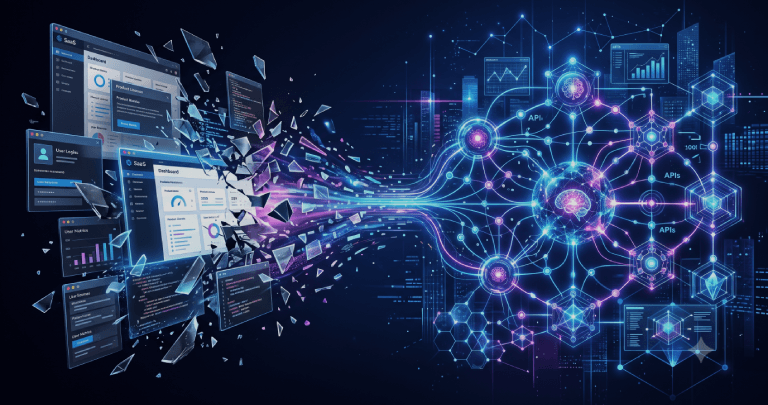
the theory that autonomous Artificial Intelligence agents could profoundly transform the SaaS market. Unlike chatbots, these agents receive goals, analyze information, access systems, make decisions within defined limits,
and execute tasks with little human intervention. A sales agent, for example, can access the CRM, analyze a customer's history,
update opportunities, prepare proposals, and schedule meetings.
Because these activities
previously required people to access different platforms, automation weakens the direct relationship between user count and
delivered value. This creates a concern that fewer professionals performing certain tasks could also mean fewer licenses purchased.
In December 2024, Microsoft
CEO Satya Nadella broadened the debate by arguing that many enterprise applications are essentially databases with business
rules, logic that agents could partially take over. The discussion intensified in February 2026, when new capabilities in
Anthropic's Claude Cowork increased fears that AI agents could replace work delivered by software, information, and services
companies. The reaction erased about US$300 billion from the sector's market value.
According to Bain &
Company, broad software indexes fell approximately 15% within a few weeks and 25% from their highs over the previous 12 months.
Even so, customer retention remained near or above 90%, indicating a reassessment of future risks rather than the immediate
disappearance of SaaS. The concern is still legitimate: AI challenges foundations that supported this model's growth for decades.
Per-user pricing may stop making sense
Charging per user makes
sense when software improves productivity. But when AI begins performing part of the work, the number of human users no longer
reflects the value delivered. A company with 500 users may need only 450 licenses after automating tasks, even as the system
becomes more important. Bain notes that AI also creates variable processing and maintenance costs. As a result, a vendor may
deliver more value with fewer users yet earn less if it relies solely on license-based pricing.
The Interface Is No Longer the Center of the Experience
With AI agents, some
screen-based navigation may disappear. Instead of manually assembling a report, a user could simply request an analysis and
action plan. The agent accesses systems through APIs and protocols such as MCP. Software can therefore remain essential behind
the scenes even when users no longer open it directly. The greatest risk falls on products whose value lies only in an interface
layered over data and processes that are easy to reproduce.
Generic features become easier to copy
AI has reduced development
costs and timelines. Tasks such as organizing documents and generating reports can now be handled by workflows that combine
models, APIs, and existing systems.
This does not mean
CRMs or regulated platforms will be replaced overnight. However, generic functions may become features within larger solutions.
According to Bain, standardized software with little proprietary data and low switching barriers is more vulnerable. Systems
with complex rules, deep integrations, and unique data are more resilient.
Why the end of SaaS may not happen
The most likely scenario
is not the disappearance of SaaS but a change in how it is accessed, integrated, sold, and priced. To operate safely, agents
need reliable data, permissions, and rules. That is why systems of record remain essential: CRMs preserve customer histories,
ERPs maintain financial information, and specialized platforms enforce controls.
AI can interpret requests,
but it should not invent account balances, change contracts without authorization, or approve payments that violate policy.
These systems remain sources of data and compliance, while agents act as an orchestration layer.
AI can use software rather than replace it
This is the argument
made by NVIDIA CEO Jensen Huang. Agents do not need to recreate spreadsheets, browsers, or CRMs when they can use mature,
integrated tools. The challenge for vendors will be making those tools accessible to AI.
Anthropic itself reinforces
this view: its agents work with Excel, Word, and enterprise systems. Rather than eliminating these products, they connect
their capabilities to execute broader processes. AI reduces clicks, but not necessarily the importance of the underlying systems.
Vendors are already adapting their platforms
Salesforce illustrates this transformation with Headless 360, which exposes data, processes, and rules through APIs, MCP, and commands for people and agents. The visual interface is no longer the only entry point, but the platform continues to provide controls and operational logic.
AI could expand the software market
Agents and SaaS can
grow together. Much of enterprise work involves coordinating ERPs, spreadsheets, email, CRM, and approvals. Bain estimates
that automating this activity represents an opportunity of roughly US$100 billion in the United States, more than 90% of which
remains untapped.
Gartner projects that
specialized agents will be embedded in 40% of enterprise applications by the end of 2026, up from less than 5% in 2025. In
an optimistic scenario, agentic AI could account for 30% of enterprise software revenue by 2035.
The trend may be less
about “agents versus applications” and more about “agents inside, on top of, and between applications.”
Autonomy still faces important limits
There is also a considerable
gap between an impressive demonstration and a reliable business operation. Agents can misinterpret information, execute unwanted
steps, be attacked through malicious content, consume more resources than expected, or make decisions that overlook the nuances
of a process. Integrations, permissions, observability, security, governance, traceability, and human oversight remain essential.
Gartner predicts that
more than 40% of agentic AI projects launched through 2027 could be canceled because of rising costs, unclear business value,
or inadequate risk controls. In 2026, the firm also placed agentic AI at the peak of inflated expectations and reported that
only 17% of organizations had deployed agents despite strong adoption intentions.
This does not invalidate
the technology. It simply shows that replacing mature enterprise systems is far more difficult than producing a demonstration
in a controlled environment.
What could actually die in the age of agents?
The SaaSpocalypse may
be targeting the wrong thing. What is threatened is not Software as a Service itself, but a specific version of the model:
closed applications that depend on manual interfaces, charge exclusively per user, and offer little differentiation through
proprietary data, knowledge, or processes.
Per-seat pricing is
unlikely to disappear completely. It still works when value is directly tied to the number of people served. However, it will
increasingly share space with pricing based on consumption, task volume, processed volume, or outcomes achieved.
The transition will
probably be gradual. In an analysis of more than 30 traditional SaaS vendors offering AI capabilities, Bain found that approximately
65% had already adopted hybrid models, combining per-user licenses with usage metrics or access to AI features. None had shifted
entirely to pricing based solely on consumption or outcomes.
The future may include
a basic subscription for human users, supplemented by charges for documents processed, tickets resolved, transactions analyzed,
opportunities qualified, or hours of work automated. In other words, customers will no longer pay only for the right to access
a tool; they will also pay for the work performed.
Who is likely to grow in the post-SaaSpocalypse world?
The winners will not
necessarily be those that abandon SaaS. They will be the companies that rebuild their products for an environment where humans
and agents work together. This means offering well-documented APIs, secure integrations, support for standards such as MCP,
granular permissions, audit logs, structured data, and mechanisms for tracking every decision an agent makes.
It also means rethinking
the experience. Software may continue to offer a visual interface for people, but it will need to provide another interaction
layer for machines. The product will no longer be merely a destination that a user must open. It will become a capability
that can be invoked at the right time within a larger process.
The best-positioned
companies will be those that control relevant data, deeply understand their customers' processes, and can turn that knowledge
into secure, measurable actions.
An attractive interface
can be replicated. A reliable history, integrated architecture, well-modeled business rules, and decades of industry knowledge
are far harder to copy.
What does the SaaSpocalypse mean for your company?
For technology buyers,
the answer is not to cancel every subscription and replace the entire environment with a generic agent. The safest path begins
with process analysis. Which activities consume the most time? Where are the repetitive tasks? Which decisions depend on information
scattered across multiple systems? Which outcomes can be clearly measured? In which situations does the level of risk allow
some degree of autonomy?
Based on these answers,
a company can integrate agents with the software it already uses, modernize legacy applications, create APIs, organize data,
and develop custom solutions for areas where off-the-shelf products do not fully meet business needs.
A prototype can prove
that AI is capable of performing a task. Turning it into a production solution requires architecture, security, governance,
monitoring, integration, and human escalation mechanisms. It is precisely in the transition from a good demonstration to a
reliable operation that software development experience makes a difference.
With 30 years of experience,
Visionnaire combines its expertise as a Software Factory with practical Artificial Intelligence projects, helping companies
integrate systems, develop agents, modernize applications, and take AI solutions from planning to production.
Will the SaaSpocalypse actually happen?
The SaaSpocalypse is
an important warning, but an incomplete prophecy. AI will put pressure on companies that rely exclusively on selling per-user
licenses. Some applications will be consolidated, features will become commoditized, and vendors that treat AI as a decorative
chatbot may lose ground.
But agents do not operate
in a vacuum. They need data, tools, rules, integrations, security, and reliable systems to turn intent into action. Therefore,
the most likely scenario is not the end of SaaS; it is the emergence of a SaaS model that depends less on screens, focuses
more on outcomes, and is designed for both people and machines.
The strategic question
is no longer, "Will AI replace our software?" The right question is: Is our software ready to be used by AI?


