

AI is redefining the developer experience, but is your company ready for this new reality?
Artificial Intelligence (AI) is profoundly transforming
software development. Tasks that once required hours of work can now be completed in minutes, code is generated from natural-language
instructions, and intelligent agents are beginning to take on increasingly complex activities. But amid so many changes, a
fundamental question arises: what does the Developer Experience look like in this new landscape?
The concept of Developer Experience (DevEx) has
always been associated with creating the ideal conditions for technology professionals to work productively, efficiently,
and with satisfaction. However, with the rise of Generative AI and coding agents, providing a good experience no longer depends
solely on suitable equipment, modern tools, and environments conducive to concentration. The challenge now is to build an
ecosystem in which developers and Artificial Intelligence work together, expanding their capabilities and accelerating innovation.
What has changed in the developer experience?
In September 2024, we published the article DevEx - What It is and why It's Important on the Visionnaire blog, highlighting the importance of investing in developers’ working conditions. At that time, factors such as high-performance computers, suitable monitors, fast networks, quiet environments, and training opportunities were essential to maximizing productivity.
These factors remain relevant. After all, even the
most advanced AI tools cannot compensate for disorganized processes, inadequate infrastructure, or a culture that hinders
innovation. The major change lies in the nature of the work itself. Previously, developers had to perform much of the programming
work directly, from writing code to debugging it. Today, intelligent tools can assist with creating features, identifying
errors, writing tests, producing documentation, and modernizing legacy systems.
As a result, professionals can devote a greater
share of their time to defining problems, designing solution architectures, validating results, and making technical decisions.
From AI-assisted coding to AI agents
The first major transformation came with the popularization
of coding assistants such as GitHub Copilot, Cursor, and other tools capable of suggesting code snippets, completing functions,
and explaining implementations. These solutions reduced the effort required for repetitive activities and made technical knowledge
more accessible. However, the evolution did not stop at coding assistance.
We are entering the era of Coding Agents, AI agents
capable of receiving objectives, analyzing repositories, modifying multiple files, executing commands, creating tests, and
proposing complete implementations. In practice, this means developers can move beyond acting exclusively as executors of
instructions and also take on the role of coordinating intelligent systems.
Imagine a team responsible for enhancing an enterprise
platform. Instead of manually implementing every change, a professional can describe a requirement, provide project context,
and delegate certain steps to an agent. While AI carries out the initial implementation, the developer monitors the process,
evaluates technical decisions, and checks whether the results meet business requirements. This model represents a significant
shift in the professional experience. Work becomes less focused on executing isolated tasks and more oriented toward problem-solving.
However, delegating activities does not eliminate the need for supervision. The greater the autonomy of agents, the more important
control, security, and validation mechanisms become.
AI Engineering: a new dimension of DevEx
This transformation is also directly related to
the consolidation of AI Engineering, a field focused on building applications using Artificial Intelligence models.
In the book AI Engineering: Building Applications
with Foundation Models, researcher and author Chip Huyen explores how foundation models are changing the development of
intelligent systems, covering model adaptation techniques, evaluation, agents, architecture, and performance optimization.
This perspective broadens the meaning of the developer experience. Simply providing access to a language model and expecting
extraordinary results is not enough. The entire engineering environment must be prepared for AI to be used efficiently, reliably,
and securely. This involves providing access to project context, integrating tools into development workflows, establishing
quality criteria, and creating mechanisms for continuous evaluation.
For example, an AI agent that is unfamiliar with a company’s architectural standards, business rules, and security restrictions may generate code that appears functional but is incompatible with the rest of the system. This is precisely where concepts such as Context Engineering and Harness Engineering become relevant. The former seeks to provide intelligent tools with the information they need to perform tasks correctly. The latter structures the execution environment, tools, permissions, and validation mechanisms that guide agent behavior. The quality of the developer experience therefore also depends on the quality of the environment built for AI.
Does greater productivity mean better results?
One of the biggest promises of Artificial Intelligence
applied to software development is increased productivity. However, there is an important difference between producing more
code and delivering more value. A developer can use AI to generate hundreds of lines of code in a matter of minutes. But if
that code contains vulnerabilities, inconsistencies, or maintainability issues, the time initially saved may turn into rework.
The State of AI-assisted Software Development 2025 report, from the DORA research program, reinforces this concern by showing that AI primarily acts as an amplifier of characteristics already present within organizations. Companies with solid processes and sound engineering practices tend to be better positioned to benefit from it, while structural problems may be intensified. This demonstrates that good DevEx in the AI Era cannot be measured solely by coding speed or the volume of code produced.
It is necessary to consider delivery quality, the
time required to release features, system stability, rework, and professional satisfaction. True productivity occurs when
technology removes obstacles and allows the team to focus its efforts on what actually generates business results.
The new challenge: avoiding Artificial Intelligence
overload
Paradoxically, the same technology that promises
to simplify developers’ work can also create new sources of complexity. With numerous tools, models, and agents available,
professionals must decide which solutions to use, how to integrate them, and how to evaluate the results produced.
Moreover, accelerated code generation can shift
part of the workload to review, testing, and maintenance. Instead of spending time writing certain features, a developer may
spend most of the day analyzing implementations produced by agents. This gives rise to a new DevEx concern: preventing the
ease of producing software from making it harder to understand, validate, and maintain.
To address this challenge, companies need to establish
clear standards for using AI, maintain appropriate review processes, and ensure that knowledge about their systems remains
accessible to teams. The goal is not simply to automate as many tasks as possible, but to create a balanced workflow in which
humans and intelligent agents contribute in complementary ways.
The developer of the future needs a new experience
The transformation of DevEx also requires changes
in education and professional development. Whereas proficiency in programming languages, frameworks, and tools was once sufficient
for many activities, skills such as software architecture, critical thinking, specification writing, and evaluation of intelligent
systems are now becoming even more important. Developers must learn not only to program, but also to guide AI, provide appropriate
context, break down complex problems, and identify limitations in generated responses.
This does not mean that traditional technical knowledge
is losing value. On the contrary: the greater AI’s ability to produce code, the more important the expertise needed
to distinguish a robust solution from a superficial implementation becomes. In this scenario, companies need to rethink their
training programs, collaboration practices, and even how they organize development teams. Professionals who are given the
autonomy to experiment with new tools, access to secure environments, and opportunities for continuous learning will be better
prepared to navigate these changes.
DevEx also comes to represent an organization’s
ability to foster a culture of collaboration between people and Artificial Intelligence.
How can your company prepare for the new DevEx?
Adopting AI-powered coding tools is relatively simple.
Turning that adoption into a competitive advantage requires a broader strategy. The first step is to understand the obstacles
limiting team productivity. Bureaucratic processes, outdated documentation, integration difficulties, and complex development
environments do not automatically disappear with the introduction of AI. Next, it is essential to establish infrastructure
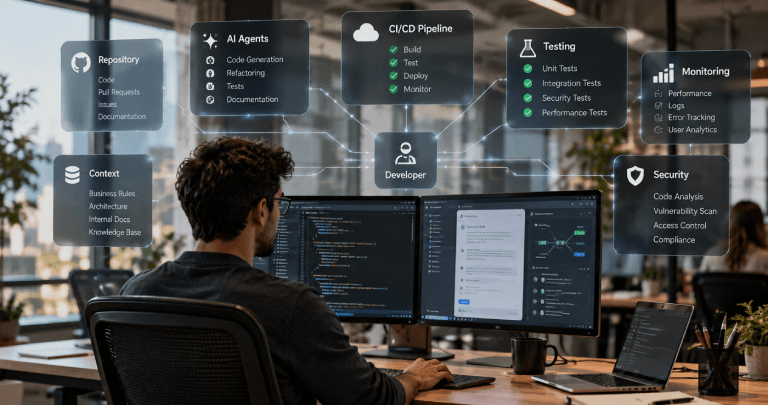
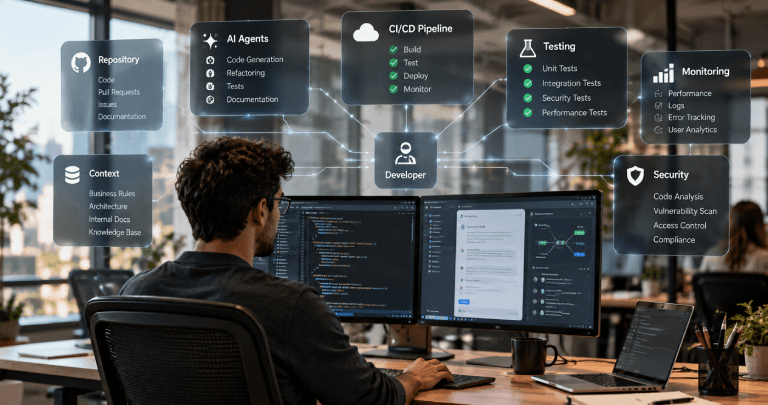
that facilitates the use of intelligent tools, including integrated development environments, CI/CD pipelines, automated testing,
and observability mechanisms. Another essential point is to provide secure access to organizational knowledge. The better
the available context, the greater the likelihood that agents will produce results aligned with the projects’ real needs.
Governance must also keep pace with this evolution.
Data protection policies, access controls, change traceability, and code reviews remain indispensable, especially as intelligent
systems begin performing tasks with greater autonomy. Finally, companies should monitor indicators that reflect concrete outcomes,
such as reduced rework, delivery speed, software quality, and the experience of developers themselves.
It is not simply about purchasing licenses for AI
tools, but about redesigning the development process to make effective use of their capabilities.
Conclusion: DevEx has evolved, and your company
needs to evolve too
Artificial Intelligence has ushered in a new chapter
in the history of software development. What was once a predominantly manual activity is becoming a collaborative process
in which professionals and intelligent agents share responsibilities.
In this context, Developer Experience takes on an
even more strategic role. Companies that invest in AI-ready environments, continuous training, and modern engineering processes
will be better positioned to turn productivity into innovation and results.
The question is no longer simply how to provide
better working conditions for developers. Now, the challenge is to enable them to leverage the full potential of Artificial
Intelligence to build smarter, more efficient, and more competitive solutions. With 30 years of experience, Visionnaire combines
expertise in software engineering, agile methodologies, and Artificial Intelligence technologies to help companies modernize
their development processes and accelerate digital transformation.
Is your company harnessing the full potential of AI in software development, or merely adding new tools to old processes? Contact Visionnaire and discover how we can help your organization advance its software engineering, upskill its teams, and turn Artificial Intelligence into real business results.


