

Know why teaching machines to understand the world could change the future of AI and business
Generative Artificial Intelligence has already changed
the way companies write, research, code, serve customers, and make decisions. In just a few years, language models have become
part of the routine for marketing, technology, sales, support, legal, product, and management teams.
But there is an increasingly important question
in the market: are LLMs (Large Language Models), by themselves, enough to take AI to the next level? The answer from some
of the leading researchers in the field is: probably not.
Language models are excellent at dealing with text.
They identify patterns, summarize documents, write code, explain concepts, and simulate conversations with impressive fluency.
However, human intelligence does not originate from text. Before a child learns to read, they have already learned a great
deal about space, objects, movement, cause and effect, risk, intention, and time. This is exactly where World Models come
in.
They represent an attempt to make AI move beyond
simply predicting the next word and begin building a broader understanding of how the world works. Not only the world described
in sentences, but the world observed in images, videos, interactions, movements, simulations, and experiences. And if this
approach works, it could become one of the biggest changes in the recent history of Artificial Intelligence.
Why LLMs impress us, but still do not understand
the world
An LLM can answer confidently about driving, physics,
human behavior, and safety. But that does not mean it has learned these concepts the way we do.
When a 16- or 17-year-old starts taking driving
lessons, they are not starting from zero. Even before sitting in the driver’s seat, they have already observed cars
on the street, watched movies, crossed avenues, understood that vehicles have speed, that collisions hurt, that curves require
caution, and that a cliff represents danger. The specific hours spent in lessons do not teach everything about the world.
They teach the person how to operate a car within a world they already know.
This is an essential point. Humans learn before
receiving formal instruction. They learn through observation, trial, error, imitation, memory, and interaction with the environment.
They know that a glass falls when released in the air, that a ball rolls down a slope, that a knife cuts, and that a child
running near the street requires attention. Much of this knowledge did not come from manuals. It came from experience.
LLMs, on the other hand, learn mainly from language.
They do not observe the world the way a child does. They have no body, they do not stumble, they do not hold objects, they
do not cross streets, they do not feel gravity, and they do not test physical hypotheses in real time. They process descriptions
of the world, but they do not necessarily build a robust intuition about it.
That is why many experts argue that scaling language
models can greatly improve AI, but may not be enough to reach AGI, known as Artificial General Intelligence.
What are World Models?
World Models are AI systems designed to create internal
representations of the world and use those representations to predict, plan, and act. Instead of merely answering “what
is the most likely next word?”, a World Model tries to answer deeper questions: “what is likely to happen if I
do this?”, “what consequences could this action generate?”, “what changed in the environment?”,
“what is the best path to reach a goal?”, “is this physically plausible?”. In simple terms, a World
Model works like a kind of internal simulator.
Imagine a robot in front of a table with objects
on it. A purely textual model may recognize the names of the items and generate instructions. A world model needs to go further:
it must understand that one object may fall, that another may block the way, that a mechanical hand has reach limits, that
too much force can break something, and that a sequence of actions needs to respect physical constraints. This difference
is enormous.
In the corporate world, this means moving from an
AI that merely talks about processes to an AI that understands contexts, anticipates impacts, learns from complex environments,
and helps make decisions that are closer to operational reality.
Yann LeCun’s vision and the role of JEPA
Yann LeCun is one of the most important figures
in modern Artificial Intelligence. He has worked for decades in areas such as machine learning, computer vision, robotics,
and image compression. He is also one of the researchers who most strongly defends the idea that the next major evolution
of AI will require something beyond LLMs.
His vision starts from a simple provocation: humans
and animals learn much more efficiently than today’s machines. A child does not need to see millions of labeled examples
to understand that an object hidden behind another object still exists. A cat does not need to read a treatise on physics
to intuitively calculate whether it can jump from one surface to another.
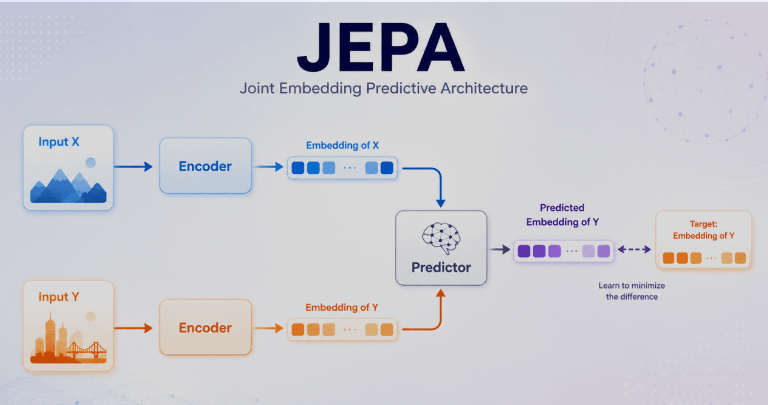
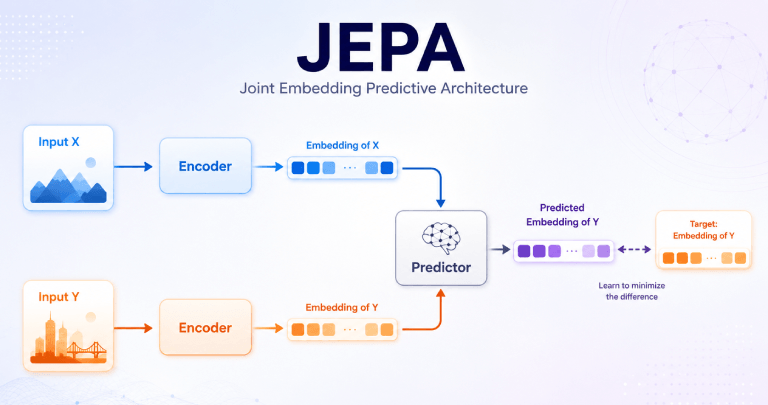
For LeCun, AI needs to learn abstract representations
of the world, capable of supporting reasoning, prediction, and planning. This is the context in which JEPA emerges, short
for Joint Embedding Predictive Architecture.
The central idea of JEPA is to make the machine
learn by predicting missing or future parts of a representation, not necessarily by reconstructing pixels or words in detail.
Instead of trying to reproduce every superficial element of reality, the system seeks to capture what is relevant within an
internal representation space.
This difference matters because the world is full
of noise. Not everything we see is essential for acting intelligently. To drive, for example, it is not necessary to memorize
every leaf on every tree along the road. But it is essential to understand that a pedestrian is crossing, that the traffic
light has turned red, that the car ahead is slowing down, and that a wet road changes braking behavior. JEPA tries to bring
AI closer to this kind of useful abstraction.
From text to video: why AI needs to observe
The advancement of World Models is directly linked
to the use of multimodal data, especially video. Videos carry information that text cannot capture with the same richness.
They show continuity, movement, transformation, depth, speed, interaction between objects, cause, and effect. A video of someone
pushing a chair teaches more about everyday physics than a sentence saying “the chair moved”.
That is why models such as V-JEPA 2 have attracted
so much attention. The proposal is to train systems at large scale with videos so they can learn to understand, predict, and
plan in the physical world. Instead of relying only on textual descriptions, AI begins to observe visual and temporal patterns.
For companies, this movement opens possibilities far beyond chatbots.
Think about industrial maintenance, logistics, property
security, retail, agriculture, healthcare, construction, urban mobility, and robotics. In all these sectors, there is a huge
amount of visual and operational information that remains underused today. Cameras, sensors, machines, vehicles, conveyor
belts, distribution centers, and production environments generate signals about the real world all the time. World Models
can transform these signals into actionable intelligence.
What Google is doing with World Models
Google DeepMind has also been investing heavily
in this direction. One of the most relevant examples is Genie, presented as a model capable of generating interactive environments.
The evolution of this type of technology points to an AI that does not merely create images or videos, but rather simulatable,
explorable, and responsive worlds. This changes the conversation.
When a model can simulate environments, it can be
used for training, planning, experimentation, and hypothesis validation. Instead of testing a strategy directly in the real
world, a company can simulate scenarios. Instead of training a robot only through physical trial and error, it can expose
it to thousands of virtual variations. Instead of relying on limited historical data, it can create situations that are rare,
dangerous, or expensive to reproduce.
Of course, there are still limitations. An AI-generated
world is not automatically faithful to the real world. Simulation is not reality. But the direction is clear: models that
understand environments and can predict dynamics may become a powerful bridge between generative AI, robotics, automation,
and decision-making.
Why this could be bigger than the current chatbot
race
The current AI race is dominated by language models.
OpenAI, Anthropic, Google, Meta, and other companies compete to build models that are faster, cheaper, safer, and more capable
of conversing, coding, and reasoning about text. But World Models may shift the center of this competition.
If LLMs were the interface that popularized AI,
world models may become the infrastructure that allows AI to act with greater autonomy in the physical and digital world.
They may enable more reliable agents, more adaptable robots, smarter industrial systems, more contextual corporate assistants,
and more useful simulations for strategic decisions.
The difference is similar to comparing someone who
has read a great deal about driving with someone who understands traffic, observes the environment, predicts risks, and makes
decisions in motion. For many businesses, this difference will be decisive. A model that simply responds well can improve
productivity. A model that understands context, predicts consequences, and plans actions can redesign entire operations.
The impact on companies: less hype, more strategy
For technology and business leaders, the most important
thing is not to treat World Models as a trend. The point is to understand that AI is moving toward a phase that is more integrated
with the real world. This requires a shift in mindset.
Companies that are still trying to discover how
to use generative AI for basic tasks should continue that movement. There is significant value in customer service automation,
document analysis, content generation, internal copilots, programming support, and intelligent search across corporate knowledge
bases. But it is also time to look at the next layer.
Where does your company have visual, operational,
temporal, or sensory data that is still underexplored? Which decisions depend on predicting consequences? Which processes
could be simulated before being executed? Which areas suffer from physical variables, risk, cost of error, or lack of context?
These questions bring AI closer to the reality of the business.
A software and AI factory with practical experience
can help precisely in this transition: moving from technological curiosity to viable, integrated, secure applications connected
to the company’s goals.
World Models do not replace LLMs; they expand
the game
It is important to avoid a simplistic interpretation.
World Models do not mean that LLMs will stop mattering. On the contrary, the trend is for different paradigms to combine.
Language models will remain fundamental for communication, explanation, conversational interfaces, programming, documentation,
and access to knowledge. What changes is that they may begin to work together with models capable of understanding video,
space, movement, actions, and consequences.
The next generation of AI will probably be more
hybrid. It may converse like an LLM, perceive like a computer vision system, simulate like a world model, remember like an
architecture with persistent memory, and act like an agent connected to tools and systems.
This is the kind of evolution that can bring AI
closer to more sophisticated applications, such as robotics, operational planning, digital twins, intelligent automation,
autonomous industrial environments, and corporate assistants with greater contextual understanding.
What this means for the future of AI
World Models represent a change in the question
being asked. For years, we asked: “how can we make AI generate the best answer?”. Now the question begins to be:
“how can we make AI better understand the situation before responding or acting?”. This shift is profound.
AI that is truly useful for complex problems needs
more than fluency. It needs perception, memory, abstraction, prediction, planning, and the ability to deal with uncertainty.
It needs to understand that the world is not made only of sentences, but of events, objects, people, movements, constraints,
and consequences. That is why this topic deserves attention.
World Models are still under development. There
are enormous technical challenges, relevant costs, security risks, simulation limitations, and many open questions. But the
potential is too great to ignore.
If LLMs taught the market to talk to AI, World Models
may teach AI to better understand the world in which business actually happens. And this could become the next major competitive
frontier.
For companies, the opportunity is not only to follow
the trend. It is to prepare now for a more contextual, multimodal, and action-oriented AI. Because when Artificial Intelligence
stops merely interpreting texts and begins predicting scenarios with greater precision, the businesses that already have organized
data, digitized processes, and prepared technology partners will move ahead.
After all, the future of AI will not be decided
only by whoever has the largest model. It will be decided by whoever can transform intelligence into real action.


