

From idea to deployment, see how specialized agents accelerate delivery with quality, security, and control
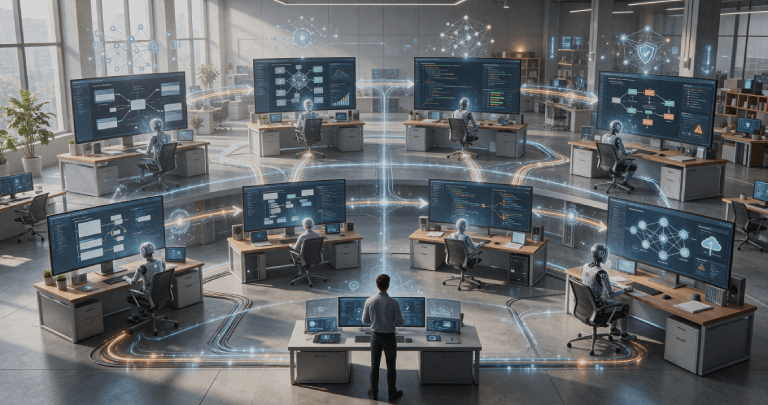
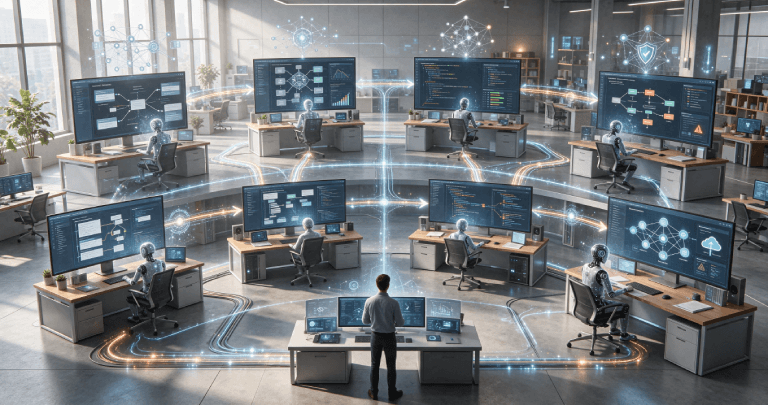
Imagine a Software Factory where different Artificial
Intelligence agents work in a coordinated way. One interprets the client’s requirements, another designs the architecture,
while others write code, run tests, check security, produce documentation, and prepare the deployment. All of this takes place
under human supervision and through continuous improvement cycles.
This scenario is becoming more than a futuristic
vision. The evolution of AI agents is beginning to transform not only programming, but the entire way software is planned,
developed, and delivered.
For companies struggling with deadlines, high costs,
overburdened teams, and growing demands for innovation, this shift represents an important opportunity: to rethink the software
development lifecycle from end to end, bringing intelligent agents together to work collaboratively. This is where the Agentic
SDLC (Software Development Life Cycle) comes in, an approach that could redefine how Software Factories operate.
What is
the Agentic SDLC?
The SDLC is the process through which software is
developed. Traditionally, it encompasses stages such as requirements gathering, planning, architecture, programming, testing,
review, deployment, and maintenance. Even with agile methodologies, DevOps, and automation tools, these activities still depend
heavily on human involvement and the transfer of information between professionals and teams.
The Agentic SDLC represents an evolution of this
model. Instead of using AI merely as an assistant for writing code, specialized agents actively participate in different stages
of development, performing tasks, using tools, checking results, and collaborating with one another.
The difference is significant. A traditional assistant
responds to a specific request, such as generating a function or fixing a bug. An agent can receive a goal, analyze a repository,
plan actions, modify files, run tests, and adjust its implementation based on the results.
Now imagine several of these agents working together,
each with specific responsibilities. This transformation is already reflected in Anthropic’s 2026 Agentic Coding Trends Report, which identifies the evolution of the software development lifecycle and collaboration among multiple agents as
important trends in software engineering. The goal is not simply to produce more code. It is to reorganize how software is
conceived, evolves, and reaches production.
From Graph
Engineering to the Agentic Software Factory
In a previous article, Visionnaire explored the
concept of Graph Engineering, which proposes organizing agents, tasks, and decisions through graphs. In this architecture, different components
are connected by relationships that determine how information flows, which tasks must be performed, and which decisions move
the process forward.
The Agentic SDLC can be understood as a practical
application of this logic to software development. Rather than merely representing how agents are organized, the graph structures
the entire workflow of a Software Factory. Each stage may involve specialized agents, conventional tools, validation rules,
and human approval checkpoints.
An architecture agent, for example, can send specifications
to front-end and back-end agents so they can work in parallel. Once the implementations are ready, a testing agent checks
the results. If it identifies problems, the task goes back to whoever is responsible for fixing them. The process does not
have to follow a rigid sequence. It can incorporate parallel tasks, conditional decisions, and verification and correction
loops while respecting the dependencies between activities. More
importantly, each agent must receive the appropriate context, understand its responsibilities, and produce results that others
can use and verify. Intelligence lies both in the agents themselves and in the way the entire process is coordinated.
A Software
Factory powered by agents: how would it work in practice?
To understand the concept better, imagine a company
that wants to add a feature to its customer portal: allowing users to track their requests in real time and receive notifications
about updates. In a conventional process, this request would pass through different professionals and stages before reaching
production. In an Agentic Software Factory, the workflow could look like the one described below.
From customer needs to requirements
The process begins with an agent specialized in
requirements analysis. It receives the initial description of the need, consults existing documentation, and identifies features,
business rules, required integrations, and potential inconsistencies. The agent can turn a general request into a structured
specification, complete with user stories, acceptance criteria, and technical constraints. It can also identify missing information
and request clarification from those responsible for the product.
From architecture to development
An architecture agent analyzes the requirements
and existing technology stack to propose the components needed for implementation. In the portal example, it could define
changes to APIs, data models, authentication mechanisms, and integration with the notification service. The proposal is then
checked against technical standards, infrastructure constraints, and architectural decisions approved by the team. From there,
development agents can receive specific tasks and work simultaneously on different system components. While one agent implements
back-end changes, another develops the user interface. A third can prepare database or integration adjustments while respecting
established dependencies. Each agent works within a defined scope, using authorized tools and repositories. The outcome does
not need to be a fully finished implementation on the first attempt. Agents can deliver incremental changes, run checks, and
request adjustments when needed.
From testing to security
Once the initial implementations are ready, a testing
agent steps in. Its responsibility is to verify that the software meets the established requirements. To do so, it can generate
test scenarios, run unit and integration tests, analyze failures, and identify unexpected behavior. If a feature fails to
meet the acceptance criteria, the agent records the problem and sends the necessary information so the code can be corrected.
This creates a continuous cycle between implementation and validation.
At the same time, an agent specialized in security
can examine the code, dependencies, and application configurations for vulnerabilities. In the portal example, it could check
whether a user can improperly access another customer’s requests, whether personal data is protected, and whether APIs
have appropriate authorization controls. These analyses complement, but do not replace, deterministic automated tests, security
tools, and specialized human assessments. The idea is to identify problems earlier, before they reach the final stages or
affect users.
From code review to documentation
Another important stage is code review. A reviewing
agent can analyze proposed changes, check compliance with development standards, identify duplication, and suggest improvements
in readability and maintainability. This review can take place through pull requests, preserving the history of modifications
and allowing human developers to approve changes, request corrections, or reject them.
At the same time, a documentation agent can update
API descriptions, changelogs, technical instructions, and support materials. Documentation is no longer an activity concentrated
at the end of a project; instead, it evolves alongside the software.
This type of work already has practical applications
in tools such as GitHub Copilot, whose agents can analyze repositories, develop changes, and prepare contributions
for review.
From deployment to monitoring
After the necessary technical checks and approvals,
the software is ready for deployment. At this point, a release agent can prepare the version, check dependencies, evaluate
the results of the CI/CD pipeline, and organize the information required for release. Deployment may first take place in a
staging environment, where additional tests verify that the application works properly. Then, in accordance with governance
policies and required approvals, the system can be released to production through controlled deployment mechanisms.
But the work does not end with deployment. Observability
agents can monitor logs, metrics, alerts, and incidents, helping identify errors and potential performance degradation. When
a problem is detected, the system can automatically open an investigation task, gather evidence, and forward it to the agents
responsible for analysis and correction. In this way, software delivery ceases to be merely the end of a sequence of activities
and becomes part of a continuous process of development, operations, and learning.
Loop Engineering:
when development begins to run in intelligent cycles
One of the foundations of this transformation is
the concept of Loop Engineering. The approach has gained prominence through initiatives such as the course Loop Engineering with LangChain Deep Agents, developed by DeepLearning.AI in collaboration with LangChain.
The idea is relatively simple: for agents to perform
complex tasks more reliably, merely allowing them to take action is not enough. Mechanisms are needed to verify what they
have done, correct problems, respond to new events, and improve their own execution environment.
In an article about Loop Engineering, LangChain presents four complementary loops. The first is the agent’s
own loop, in which it analyzes a task, uses tools, observes the results, and decides what to do next. The second is the verification
loop, in which the result is evaluated against defined criteria. When failures occur, the agent receives feedback and can
try again. The third is the event-driven loop. A new request, a failed test, or a monitoring alert can automatically trigger
another execution. The fourth is the continuous improvement loop, in which records from different executions are analyzed
to identify opportunities to refine instructions, tools, and coordination mechanisms.
Applied to the SDLC, these principles can make development
more adaptive. A failed test triggers a fix. An identified vulnerability initiates a review. A production incident provides
information for a new change. It is important to emphasize that this improvement does not mean AI models automatically learn
from every task. Improvement comes through the controlled evolution of the processes, configurations, evaluations, and resources
used by the agents. The key difference is turning isolated actions into work cycles that are verifiable, traceable, and progressively
more efficient.
The human
role becomes even more strategic
Faced with a Software Factory made up of agents,
a natural question arises: what role will development professionals play? The answer involves a shift in responsibilities.
If some implementation, testing, and documentation work can be delegated to AI, professionals will have more opportunities
to focus on what requires business understanding, critical thinking, architectural decisions, and risk assessment.
Developers also become guides and reviewers of the
work performed by agents. Architects define boundaries and technical standards. Security specialists establish policies and
validate critical situations. Product Owners ensure that solutions genuinely meet users’ needs. Software engineering
becomes less centered on manually executing each task and more focused on defining, coordinating, and validating results.
This does not eliminate the need for technical expertise. On the contrary, it requires professionals who can identify errors,
evaluate alternatives, and recognize when a seemingly correct solution is not appropriate. Responsibility for the software
remains with people, even when its implementation involves a high degree of automation.
Greater
speed must not mean less control
Although the Agentic SDLC offers promising possibilities,
adopting it also presents challenges. An agent may misinterpret a requirement, propose an unsuitable solution, introduce vulnerabilities,
or make changes beyond its intended scope. In addition, collaboration among multiple agents increases the need to manage permissions,
share information correctly, and keep records of the decisions made.
OWASP, an international reference in application security, recommends that agent-based systems
adopt practices such as least privilege, input validation, environment isolation, monitoring, and human approval for high-risk
actions. Within a Software Factory, this means that agents should not have unrestricted access to repositories, credentials,
databases, or production environments. It is also important to ensure that automation is integrated with established quality
processes, such as continuous testing, static analysis, code review, version control, and deployment policies. Operational
costs are another concern. Excessive execution loops, agents duplicating tasks, and unnecessary checks can consume resources
without delivering proportional benefits.
An efficient agentic Software Factory, therefore,
is not the one with the most agents, but the one that can assign the right responsibilities, with appropriate controls, to
deliver better results.
How can
companies begin this transformation?
Adopting the Agentic SDLC does not require overhauling
the entire development operation at once. A safer approach is to start with well-defined activities that have verifiable results
and low operational risk. A company can, for example, test a workflow in which one agent implements a change, another prepares
and runs tests, and a third performs a preliminary review. All of this happens before approval by a responsible developer.
As the team gains experience, other agents can be added to support requirements, architecture, documentation, and operations.
What matters is establishing clear success criteria, tracking indicators such as delivery time, rework rate, defects identified,
cost per task, and implementation quality. It is also necessary to build the technological foundation that will enable this
collaboration, including well-organized repositories, up-to-date documentation, isolated environments, secure integrations,
and observability mechanisms. Without these elements, simply adopting more advanced agents is unlikely to be enough to transform
development.
The future
of Software Factories is increasingly agentic
For decades, software engineering has evolved through
the creation of tools that increase developer productivity. Now a new stage is beginning: building systems in which different
AI agents can collaborate throughout the development lifecycle. The Agentic SDLC represents this change in perspective. The
focus is shifting from merely automating individual tasks to considering how the entire process can be redesigned.
For businesses, the potential lies in reducing bottlenecks,
accelerating feature delivery, improving operational continuity, and enabling skilled professionals to devote more time to
innovation and business needs. However, the real breakthrough will not come from replacing people with agents, but from combining
AI’s execution capabilities with human experience, creativity, and judgment.
With 30 years of experience, Visionnaire brings
together expertise in software development and Artificial Intelligence to help businesses modernize their applications and
explore new opportunities for innovation. Discover our Software Factory and AI Factory offerings and learn how to prepare
your business for this new stage of software engineering. The future is not just about developing software with AI. It is
about rethinking how all software can be developed.


