

Organize agents, tasks, and decisions into graphs to build more coordinated, traceable, and scalable AI systems
The evolution of Artificial
Intelligence applied to software development is rapidly changing the way we think about systems, automation, and even digital
teams. First, we learned to communicate better with models through Prompt Engineering.
Then, we realized that writing good commands was not enough: it was necessary to provide the right context, giving rise to
Context Engineering. Next came approaches such as Harness Engineering and Loop Engineering, focused on providing
agents with tools and creating cycles capable of planning, executing, verifying, and trying again. Now, a new layer is beginning
to gain traction: Graph Engineering.
The idea stems from
an increasingly common problem. As systems based on AI agents become more sophisticated, expecting a single agent to understand
the entire problem, execute every step, validate its own work, and maintain all the necessary state begins to create limitations.
Instead of concentrating
all this responsibility in a single intelligence, why not organize different agents, tasks, and decisions as parts of a connected
graph? This is precisely where Graph Engineering
begins to show its potential.
From the isolated agent to system intelligence
An academic paper published
in August 2026 describes Graph Engineering as an emerging paradigm for systems
based on LLM agents. Its proposal is to move beyond optimizing only the intelligence of an individual agent and advance toward
what the authors call System Intelligence.
This is because real-world
tasks cannot always be solved efficiently by a single intelligence. Developing an enterprise application, for example, may
require interpreting requirements, analyzing the existing architecture, developing different components, integrating with
APIs, running automated tests, performing security assessments, reviewing code, and obtaining approval before release.
An extremely powerful
agent could try to handle everything. Graph Engineering proposes another
approach: turning these responsibilities into an explicit work structure. In this scenario, intelligence is not only inside
each agent. It also lies in how all of them are organized.
What is Graph Engineering?
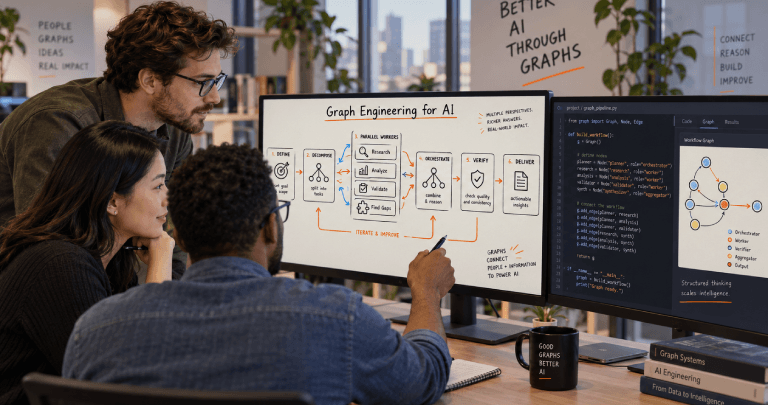
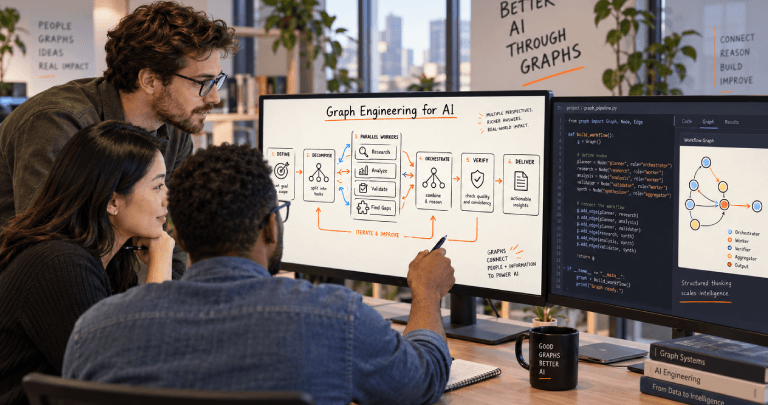
In simple terms, Graph Engineering is the practice of structuring a system of agents, tasks, and
decisions as a graph. A graph is primarily made up of nodes and connections. Nodes represent units of work. A node can be
a specialized AI agent, a traditional software function, a validation mechanism, an external tool, or even a step that requires
human approval. The connections, known as edges, determine how work moves from one node to another.
Imagine a node responsible
for interpreting a customer request. From there, the flow can move to an architecture agent. At that point, different paths
can be triggered simultaneously for Back-End, Front-End, databases, and integrations. When those tasks are completed, another node can run tests. If failures
are found, the flow can automatically return to the agent responsible for implementation.
The application therefore
stops depending solely on a rigid sequence of instructions. It begins to have an execution topology. In recent approaches,
this structure typically involves specialized nodes, edges that define conditional, sequential, or parallel routes, and some
form of shared state mechanism that keeps the necessary information available during execution.
From Prompt Engineering to Graph Engineering
It is important to
understand that Graph Engineering does not necessarily replace everything
that came before it. A good agent-based system will still need good prompts.
It will also need to carefully control what context each agent receives. Tools, memory, integrations, and validation mechanisms
remain essential. What changes is the scale of the problem.
Prompt Engineering focuses
on the instruction given to the model. Context Engineering seeks to ensure
that the model has access to the right information at the right time. Harness Engineering
organizes the tools, resources, and infrastructure that allow the agent to actually work. Loop Engineering enables a given agent to execute, observe results, check for errors, and repeat its work
until it reaches a goal.
Graph Engineering, in turn,
focuses on organizing these intelligences and processes as a larger system. A node in the graph can even be an agent operating
within its own loop. Therefore, graphs and loops are not necessarily competing alternatives. In complex systems, a graph can consist precisely of several
specialized loops that communicate with one another.
An example inside a Software and AI Factory
Consider a company
that wants to develop a new feature in its system. In a traditional single-agent architecture, the request could be sent to
an AI with the expectation that it will analyze the requirement, understand the system, code the feature, run tests, and make
the necessary corrections.
With Graph Engineering, the process can be much more specialized. A first node interprets the business need and
turns the request into technical requirements. Another evaluates the existing architecture. Implementation can then be divided
among different specialized agents.
Once the code is ready,
an independent agent runs tests. Another performs a security analysis. Another verifies architecture and quality standards.
If a step fails, the graph determines which node the work should return to. Only after the necessary checks can the flow reach
a final approval or deployment stage.
This creates an important
difference: the process no longer depends exclusively on the reasoning capacity of a single agent and also gains a coordination
architecture. It is like turning an excellent individual professional into an organized digital team.
The graph can also decide which paths to take
One of the most interesting
characteristics of this approach is that not every flow needs to be linear. Depending on the result produced by a given agent,
different paths can be chosen. If an analysis agent identifies that a change affects only the interface, there may be no need
to trigger database-related steps. If the change involves sensitive data, an additional security node may become mandatory.
If the tests fail, the flow returns to development. If they pass, the work moves forward.
Parallel processes
can also exist. While one agent develops a particular integration, another can prepare tests and a third can update the documentation. The graph therefore represents not only who performs each task, but also under what circumstances each task should
take place.
Graph Engineering and Knowledge Graphs are not the same thing
There is an important
distinction. The term "graph" also appears in Knowledge
Graphs. In this case, the main objective is to represent information and, above all, the relationships between it.
A DeepLearning.AI course
on Agentic Knowledge Graph Construction, developed in partnership with Neo4j,
demonstrates specialized agents collaborating to analyze structured and unstructured data, propose nodes and relationships,
and build a Knowledge Graph. The example shows how multi-agent systems can
both operate through coordinated flows and use graphs as knowledge structures. It is a particularly interesting combination
for enterprise applications.
More context without simply increasing the context window
One of the problems
with large agent systems is assuming that the solution to more complex tasks always consists of giving the AI more information.
Not necessarily. The larger the context provided, the harder it can become to identify what really matters for that specific
stage.
A graph-oriented architecture
allows each node to receive only the information relevant to fulfilling its responsibility. The agent responsible for testing
does not necessarily need to receive the entire conversation history from the requirements-development process. It needs to
understand what should have been implemented, which criteria must be evaluated, and what result was produced. This separation
creates context boundaries. Recent projects related to the Graph Engineering
concept also highlight this ability to make long workflows more observable, testable, and recoverable, preventing all the
logic from being hidden inside an enormous context window or monolithic instructions.
Traceability can become a decisive advantage
When agents begin to
perform important activities inside a company, one question inevitably arises: How can we know why the AI made a particular
decision? In a large workflow executed by a single agent, reconstructing the path taken can be difficult.
Explicit graphs help
create a more observable structure. It is possible to record which nodes were executed, what results they produced, which
conditions caused the system to choose a particular path, and where a possible failure occurred. This is especially valuable
in enterprise systems, where reliability, auditing, and control can be just as important as the model’s own capabilities.
The graph turns part of the AI’s behavior into visible architecture.
Specialized agents instead of one agent that does everything
There is another important
consequence. With a graph-based architecture, it becomes easier to use different agents according to their specialties. One
model may be excellent at programming. Another may be better suited to document interpretation. Another may handle validation.
Some tasks may not even require an LLM and can be executed with conventional code, which is more predictable and less expensive.
A node can also represent a human decision.
This approach makes
it possible to choose the right intelligence for each stage instead of using the most powerful model available for the entire
process. For companies, this can mean systems that are potentially more controllable, efficient, and economically sustainable.
Not every problem needs to become a graph
Graph Engineering should
also not be treated as a mandatory solution for every AI application. Turning a simple process into a large network of agents
can increase complexity without delivering real benefits.
If an activity can
be performed reliably by a single agent, adding multiple nodes, states, routes, and synchronization mechanisms will probably
be unnecessary.
The concept itself
should still be understood as an emerging paradigm, rather than a universal protocol or a single technology. Different implementations
use graphs in different ways to coordinate agents, states, and processes. The value emerges when the complexity of the work
begins to exceed what a single flow can adequately manage.
From Artificial Intelligence to organizational intelligence
The most interesting
change brought by Graph Engineering may not lie in the graphs themselves.
It lies in the way we are beginning to think about agents. Until recently, much of AI evolution was focused on making a single
model more intelligent, capable of understanding more information and performing more activities.
Multi-agent systems
change this logic. Instead of asking only, "which model is capable of solving this problem?", we can start asking, "how should
different intelligences collaborate to solve this problem?"
It is a transformation
similar to what happens in human organizations. A company does not work because one person knows how to do everything. It
works because specialized professionals collaborate within processes, responsibilities, controls, and information flows. Graph Engineering brings this logic to software systems made up of agents. And
as these agents gain autonomy, tools, memory, and the ability to perform real tasks, correctly designing the connections between
them can become just as important as choosing the AI models themselves.
The next step toward truly agentic systems
The trend in the coming
years will likely not be merely the presence of more agents inside companies. The challenge will be making these agents work
together reliably. This requires architecture, rules, context, states, validation, observability, and processes
capable of handling errors and changes in direction. This is precisely where Graph
Engineering becomes relevant.
In practice, developing
intelligent software will not simply mean putting AI inside an application. It will mean designing systems in which different
intelligent components can collaborate, verify one another’s work, and move along paths defined according to each situation.
With 30 years of experience
in software development and closely following the evolution of Artificial Intelligence, Visionnaire helps companies turn these
new possibilities into real solutions by integrating software architecture, automation, and AI to create applications prepared
for increasingly complex challenges.


