

Understand the five layers that power AI and discover where your business can create value in this new economy
When we think of Artificial Intelligence, we usually
picture advanced models, chatbots, intelligent agents, and tools capable of performing complex tasks. Yet behind every response
generated by AI lies a vast industrial value chain, made up of energy, processors, technological infrastructure, and specialized
systems.
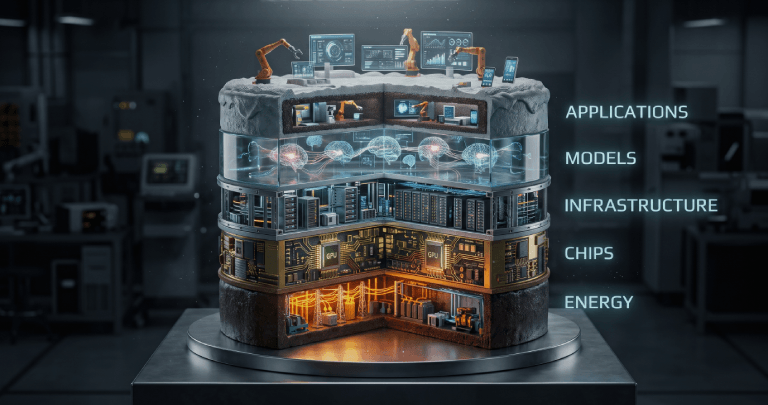
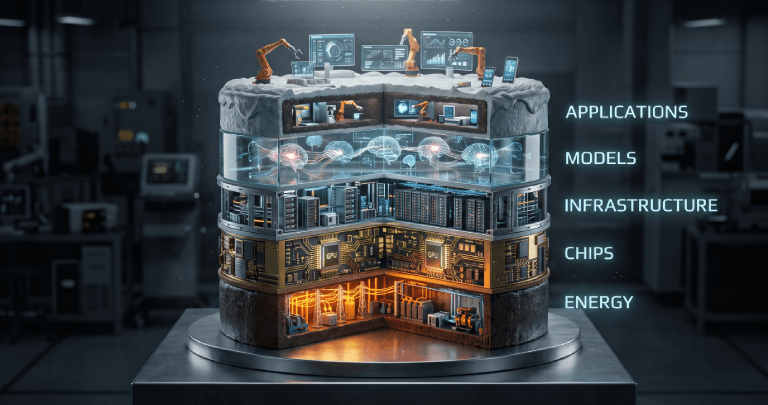
This is the central idea behind the Five-Layer Cake,
a metaphor used to explain how the Artificial Intelligence industry works. The concept shows that AI is not merely software
or a language model. It is an ecosystem made up of five interdependent layers, each supporting the next.
The metaphor also helps explain why energy companies,
chip manufacturers, cloud providers, model developers, and software factories are all part of the same revolution. More importantly,
it reveals where business opportunities lie and how organizations can turn this technological capacity into tangible results.
A new industry is being built
For decades, computers have operated based on programs
that execute predefined instructions. With the evolution of Generative Artificial Intelligence, a different dynamic has emerged:
systems capable of interpreting information, understanding context, and producing responses in real time.
This shift requires an infrastructure far larger
than we typically imagine. Every interaction with an AI model consumes computing capacity, which depends on specialized equipment,
physical infrastructure, and an energy supply.
From this perspective, Artificial Intelligence can
be understood as an industry that transforms energy and computing power into digital intelligence. Its units of output include
tokens, which models use to process and generate information. This is where the Five-Layer Cake comes in, organized from bottom
to top into five layers: Energy, Chips, Infrastructure, Models, and Applications.
First layer: Energy, the foundation of all Artificial Intelligence
The first layer of the cake is also the most fundamental:
energy. It may seem odd to begin an explanation of Artificial Intelligence by talking about electricity, but there is a simple
reason: no model can run without computers, and no computer can run without energy.
Training and running advanced models require substantial
processing power. The more sophisticated the applications and the greater their use, the higher the energy demand needed to
support them may be.
That is why the expansion of AI is directly tied
to electricity generation and distribution capacity, energy efficiency, and the development of cooling systems.
This connection also creates new opportunities for
renewable energy sources, smart power grids, and technologies that can deliver greater computing capacity while consuming
less energy.
Energy is no longer merely an operating expense;
it has become a strategic factor in the expansion of Artificial Intelligence. After all, access to electricity can determine
how much the entire industry is able to grow.
Second layer: Chips, the engines of the new revolution
Above energy are chips, which turn electricity into
processing capacity. This layer includes GPUs, specialized AI accelerators, and other components designed to perform mathematical
operations at scale. Unlike traditional processors, many of these devices are built to carry out thousands of calculations
simultaneously, an essential capability for modern AI models.
This is the layer where companies such as NVIDIA
play a crucial role, developing architectures that increase processing speed and improve computing efficiency.
Advances in chips directly influence the economics
of AI. More efficient processors can allow models to run faster, consume less energy per operation, and reduce the cost of
producing digital intelligence.
One increasingly relevant concept in this context
is Tokens
per Watt, which relates the number of tokens produced to the energy consumed. The greater the efficiency, the more intelligence
can potentially be generated using the same energy resources.
In other words, competition is not just about developing
the most intelligent models, but also about finding economically viable ways to run them.
Third layer: Infrastructure, where AI factories take shape
Having advanced chips is not enough. They must be
connected, organized, and made to work in coordination. That is the purpose of the third layer: the technological infrastructure
that supports Artificial Intelligence.
This includes data centers, servers, high-speed
networks, storage, cooling systems, cloud platforms, and software that manages computing resources.
At this layer, the concept of the AI Factory gains
prominence, describing computing facilities designed to produce digital intelligence at scale.
While traditional data centers were primarily designed
to store, process, and distribute information, AI Factories are specifically built to handle intensive Artificial Intelligence
workloads. Their purpose is to turn computing capacity into outputs continuously produced by models, including answers, analyses,
predictions, and intelligent actions.
For businesses, this layer involves important decisions
about scalability, availability, security, costs, and technology architecture. After all, an AI solution that performs well
in a pilot project must remain efficient when it begins serving hundreds or thousands of users.
Fourth layer: Models, where intelligence takes shape
The fourth layer is probably the one most familiar
to the public. It encompasses the Artificial Intelligence models responsible for interpreting information, recognizing patterns,
generating content, and performing a wide range of cognitive tasks.
This is the world of Large Language Models (LLMs),
such as those used in conversational tools, as well as multimodal models capable of working with images, audio, video, and
other types of information.
The industry goes far beyond text generation. There
are specialized models for biology, chemistry, medicine, physics, robotics, and many other fields of knowledge. This diversity
creates room for increasingly specific applications tailored to the needs of different economic sectors.
For an organization, however, using AI does not
necessarily mean developing a model from scratch. Often, the most efficient approach is to select existing models, connect
them to corporate data, and adapt them to business processes. This can involve techniques such as RAG (Retrieval-Augmented
Generation), specialized fine-tuning, and response validation mechanisms. The challenge is to strike the right balance between
quality, performance, privacy, reliability, and cost.
The best model for a company will not always be
the most powerful one, but the one that delivers the required results safely and cost-effectively.
Fifth layer: Applications, where AI becomes business value
At the top of the cake is the applications layer.
This is where the entire structure built across the previous layers finds its economic purpose. It encompasses solutions that
use Artificial Intelligence to solve real problems, improve processes, develop products, and create new business opportunities.
These include AI agents capable of automating activities,
intelligent customer service systems, document analysis platforms, software development support tools, medical applications,
industrial systems, and robotics solutions.
An intelligent agent integrated with enterprise
systems, for example, can retrieve information, interpret requests, execute processes, and help professionals make decisions.
The value lies not simply in using an advanced model,
but in turning its capabilities into something useful for the business. This is why the applications layer matters so much.
All the investment in energy, chips, infrastructure, and models needs to be matched by demand for solutions that deliver tangible
benefits.
For companies looking to adopt Artificial Intelligence,
this is a crucial insight. Adopting AI should not be an end in itself. The goal should be to increase productivity, reduce
costs, improve the customer experience, or create new revenue streams.
Five layers, one value chain
The most interesting aspect of the Five-Layer Cake
is the interdependence of its layers. An AI application needs models to function. Models depend on computing infrastructure.
That infrastructure uses specialized chips, which require energy to operate. When one of these layers faces constraints, the
effects can be felt throughout the others.
Conversely, advances in one layer can drive progress
across the entire ecosystem. More efficient chips reduce computing costs. More modern infrastructure expands processing capacity.
Better models enable applications that were previously impossible. New applications increase demand across the entire value
chain. The result is a cycle of technological and economic development.
This dynamic also explains why Artificial Intelligence
attracts such diverse investments, ranging from power plants and semiconductor manufacturers to specialized startups and major
software companies.
AI is moving beyond being just another category
of technology and is establishing itself as a general-purpose infrastructure, with the potential to transform virtually every
sector of the economy.
What does the Five-Layer Cake mean for businesses?
Understanding the five layers is important, but
that does not mean every organization needs to invest directly in all of them. A company does not need to manufacture chips,
build data centers, or develop its own foundation models to participate in the Artificial Intelligence economy.
In most cases, its greatest opportunity will lie
in the applications layer, leveraging existing technologies to create solutions tailored to specific business needs.
The real competitive advantage may lie in the ability
to integrate AI models with enterprise systems, use strategic data, automate processes, and develop intelligent applications.
This requires expertise in software architecture,
systems integration, security, data governance, and AI engineering. It also demands a clear understanding of the problems
to be solved and the results expected. After all, there is little value in having access to the most advanced models on the
market if an organization cannot turn them into practical, reliable, and scalable solutions.
The Five-Layer Cake delivers an important message:
the Artificial Intelligence revolution depends on an entire industry, but the value each company captures comes from its ability
to apply the technology intelligently.
From infrastructure to innovation: the role of software and AI factories
While the lower layers make Artificial Intelligence
technically possible, the top layer puts it to work for businesses. This is where Software and AI Factories play a strategic
role, connecting advanced technologies with organizations' real-world challenges.
The challenge goes beyond adding AI features to
existing systems. It involves rethinking processes, developing new applications, and building solutions capable of delivering
measurable results.
With 30 years of experience in software development,
Visionnaire operates at the intersection of technology and business, helping companies turn opportunities into digital solutions.
The next stage of the AI revolution will not depend solely on those producing the fastest chips or the most sophisticated models. It will also depend on those who can leverage this entire ecosystem to solve problems, innovate, and create value.
The infrastructure for Artificial Intelligence is
being built. The competitive advantage will lie in knowing what to do with it.


