

Boris Cherny shows why job titles matter less than the ability to create, evolve, and sustain products
For decades, companies
organized their technology teams around seemingly clear boundaries. Engineering built, Product set priorities, Design shaped
the experience, and Data Science turned data into models and forecasts. Artificial Intelligence, however, is making these
divisions increasingly permeable.
Today, a designer can
create a functional prototype, a product manager can investigate a codebase, and a developer can build interfaces, analyze
metrics, and speak directly with customers. This does not mean everyone has become an expert in everything. It means tools
are expanding each professional's reach and shifting part of the value from technical execution to the ability to understand
problems, make decisions, and guide intelligent systems.
It was in this context
that Boris Cherny, creator and head of Claude Code at Anthropic, shared a reflection on how Engineering, Product, Design,
Data Science, and other disciplines are merging into a new category of work. Rather than proposing new job titles, Cherny
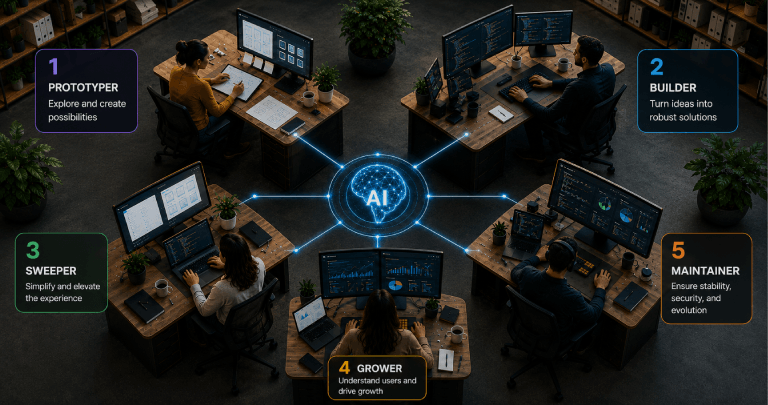
identified five archetypes he sees within his own team: Prototyper, Builder, Sweeper, Grower, and Maintainer.
More than a discussion
about professional titles, his proposal helps answer a strategic question: what behaviors does a team truly need to turn an
idea into a relevant, scalable, and enduring product?
Why Boris Cherny's
opinion deserves attention
Cherny is uniquely
positioned to observe the transformation of software development. He joined Anthropic in late 2024 with a mandate to experiment
with applications for advanced AI models. In roughly one month, he created a terminal program capable of interacting with
the Claude API to write and modify code. The tool began to be used internally and soon became Claude Code.
Introduced publicly
in February 2025, Claude Code emerged as an agentic coding tool through which developers could delegate substantial engineering
tasks directly to an AI model. In the months that followed, it also gained integrations with development environments, background
tasks, and increasingly autonomous workflows.
Cherny's own workflow
symbolizes this shift. In interviews, he has said that he stopped writing code manually and began directing multiple agent
sessions that implement, test, and modify systems in parallel. Instead of acting only as the author of every line, he works
as someone who defines objectives, provides context, evaluates decisions, and coordinates computational capabilities.
That does not make
his view an infallible prediction. It does, however, make it an account from someone who is building and using, every day,
one of the tools pushing hardest against the traditional boundaries of software engineering.
Job titles are not
disappearing overnight, but their boundaries are
The main provocation
in the tweet is not the names chosen for the five archetypes. It lies in
the distinction between the role shown on an organizational chart and the contribution actually made to the product.
An engineer may act
as a Prototyper on one project and as a Maintainer on another. One designer may excel at refining existing experiences, while
another stands out for creating entirely new concepts. Product managers, data scientists, and developers can also move between
two or three archetypes.
Cherny is therefore
not suggesting that companies replace conventional roles with five new job titles. The idea is that these archetypes describe
inclinations, capabilities, and types of impact that can exist across different professionals. The same team may have several
people performing the same function, while one person may combine different profiles.
This distinction is
essential. Without it, the convergence of disciplines could be interpreted as a demand for every professional to know how
to do absolutely everything. In reality, AI expands the ability to cross boundaries, but it does not eliminate the need for
experience, judgment, and deep expertise.
the Prototyper:
turning uncertainty into something testable
The Prototyper is driven
by exploration. This person imagines possibilities, combines technologies, and quickly creates early versions of products,
features, or experiences. Many of these ideas may never reach the market, and that is not necessarily a problem.
The Prototyper's contribution
is to replace abstract discussions with something that can be seen, used, and challenged. In an environment where AI agents
can generate interfaces, integrations, and functional applications in a short time, experimentation has become far less expensive.
As a result, producing many ideas and discarding most of them may be more efficient than trying to choose the perfect alternative
before building anything.
Yet speed without intention
merely multiplies prototypes. A strong Prototyper does not measure success by the number of demos produced, but by the amount
of uncertainty eliminated. Each experiment should help the team better understand the user, the problem, or the solution's
feasibility.
The history of Claude
Code itself illustrates this archetype. The tool began as a simple program, without a graphical interface or an elaborate
launch strategy. Its spontaneous adoption within Anthropic signaled that a meaningful product was taking shape.
The Builder: taking
an idea from “it works” to “it can go into production”
A prototype may impress
during a presentation and still be far from a real product. The Builder occupies that gap. This archetype turns an initial
idea into reliable software. The Builder organizes the architecture, integrates systems, structures tests, handles errors,
implements security, prepares the infrastructure, and ensures the solution can be used outside a controlled environment.
AI has made initial
creation extraordinarily fast, but it has also increased the number of projects that reach companies without being ready to
scale. Code generated in minutes may work in the expected scenario and fail when it encounters real data, business rules,
legacy systems, or thousands of simultaneous users.
For that reason, the
Builder is likely to become more important, not less. The easier it becomes to produce prototypes, the greater the need for
professionals who can determine what should be preserved, rebuilt, or discarded before a solution reaches production.
This is also where
experience and technical accountability become decisive. AI can suggest implementations, but someone still needs to ensure
that the choices fit the business, the technology environment, and the organization's risks.
The Sweeper: simplifying
is also a form of development
Cherny uses the term
Sweeper to describe someone who removes complexity, improves the interface,
simplifies the code, increases performance, and even removes features that no longer make sense.
This profile often
receives less attention because the work does not always result in a new feature. Frequently, the Sweeper's greatest achievement
is making the product feel simpler after a significant technical intervention.
In rapidly evolving
systems, every new delivery can add dependencies, rules, screens, exceptions, and maintenance costs. As AI increases the amount
of code a team can produce, the risk of accumulating complexity also grows. Generating more code does not necessarily mean
creating more value.
The Sweeper challenges
excess. This person looks for duplication, unnecessary steps, confusing experiences, and decisions that worked in the past
but are no longer justified. This work preserves the product's ability to evolve.
There is also an important
lesson for managers: removing a feature can be just as strategic as launching one. Mature products do not improve only through
the continuous addition of capabilities. They often improve when a company finds the courage to simplify.
The Grower: turning
usage into market fit
Once the product has
been built, a less visible and often more difficult stage begins: making it indispensable to an audience. The Grower works on something that already exists. This person observes user behavior, speaks with customers,
analyzes data, tests improvements, and seeks to strengthen the fit between the solution and the market.
This is not merely
a matter of marketing or commercial growth. The Grower works on the product itself, helping determine which features generate
value, which obstacles hinder adoption, and which adjustments can improve activation, retention, and satisfaction.
AI tools accelerate
this work by analyzing interactions, synthesizing feedback, producing variations, and supporting experiments. Even so, interpreting
human behavior still requires sensitivity. A metric can reveal where a user abandoned a journey, but it cannot explain on
its own why that happened or which change will preserve the product's core proposition.
This archetype is especially
important once the solution has achieved some degree of Product-Market Fit,
meaning there are consistent signs that it solves a real market need. From that point on, the challenge is no longer merely
proving that the idea works, but deepening, expanding, and sustaining its relevance.
The Maintainer:
protecting what has become essential
When a system matures,
downtime is no longer merely a technical problem. It can interrupt sales, customer service, operations, and critical decisions.
The Maintainer is responsible for ensuring that established products remain secure, fast, reliable, and efficient as they
grow. This work involves observability, failure prevention, cost control, dependency updates, security, performance, and incident
recovery. The role may appear conservative amid the excitement surrounding innovation, but it is precisely what allows a company
to innovate without putting the entire business at risk.
AI agents can already
assist with failure investigation, code review, test creation, and vulnerability identification. Even so, maintenance requires
accumulated knowledge of the system, its history, and its operational consequences. A technically elegant fix may be inappropriate
if it changes behavior on which customers or integrations depend.
The Maintainer represents
the team's memory and sense of responsibility. In a scenario where creation is becoming easier, sustaining quality may become
one of the greatest competitive differentiators.
The ideal combination
depends on the product stage
Cherny also relates
the archetypes to the stage each solution has reached. New products that are still far from Product-Market Fit primarily need Prototypers, Builders, and Sweepers. They must experiment, turn ideas into
working solutions, and prevent speed from generating premature complexity.
When a product finds
its market and begins to grow, Builders, Sweepers, and Growers take center stage, accompanied by a growing presence of Maintainers.
Established products depend more heavily on Growers, Sweepers, and Maintainers, although they still need some building capability.
This perspective can
change how companies hire and allocate professionals. A team may have outstanding resumes and still fail because everyone
enjoys starting projects and no one wants to sustain them. In another organization, operations may be extremely reliable,
yet there may be no room to experiment with something new. The challenge, therefore, is not simply finding talent. It is assembling
the right combination of behaviors for the product's stage and objectives.
Andrej Karpathy
and Software 3.0
Cherny's view connects
with the concept of “Software 3.0,” popularized by Andrej Karpathy. In his interpretation, development has undergone
another paradigm shift: in addition to traditional code and neural networks trained on data, we now use models that can be
programmed through natural language.
This turns human language
into a new computing interface. People without deep command of a programming language can describe intentions, request implementations,
and produce digital artifacts. At the same time, experienced developers begin operating at a higher level of abstraction,
coordinating models and evaluating results.
The consequence resembles
the shift described by Cherny. When writing every line is no longer the only way to build software, professional identity
moves as well. Understanding the problem, defining objectives, creating strong evaluations, and recognizing inadequate solutions
become as important as the ability to implement manually.
This does not mean
the end of technical knowledge. Quite the opposite: professionals who understand architecture, security, data, and user experience
can assess AI-generated output more accurately. Knowledge stops being only an instrument of execution and also becomes an
instrument of direction and control.
Dylan Field and
the rise of “product builders”
Dylan Field, co-founder
and CEO of Figma, reached a similar conclusion from a different direction. In his view, AI is encouraging the convergence
of functions such as Design, Engineering, Research, and Product, turning different professionals into “product builders”
with their own specializations.
A survey cited by Field
indicated that many professionals are already performing activities beyond the traditional boundaries of their roles. At the
same time, most still recognize the importance of deep specialization in producing high-quality work.
This combination helps
prevent a mistaken interpretation: the company of the future will not necessarily be made up only of generalists. It will
more likely be made up of specialists who can collaborate across broader territories.
A designer does not
need to become the best engineer on the team, but can use AI to create a functional implementation of a proposal. A developer
does not need to replace a researcher, but can analyze usage data before making a technical decision. Boundaries become more
flexible without making depth any less valuable.
Dario Amodei and
an even more radical prediction
Dario Amodei, CEO of
Anthropic, offered a more aggressive prediction by suggesting that AI models could take over most of the activities currently
performed by software engineers within a relatively short period.
Even within Anthropic,
however, this automation has not meant the absence of professionals. Cherny argues that engineers are still needed to guide
models, speak with customers, coordinate decisions, and determine the direction of products. The work changes because execution
is shared with agents, not because all responsibility disappears.
The difference between
the two positions lies less in the destination than in the focus. Amodei emphasizes the growing capabilities of machines.
Cherny seeks to describe how humans can organize themselves around those capabilities.
The more tasks AI assumes,
the greater the weight of the decisions that remain with people. Deciding what to build, whom to build it for, which risks
to accept, and when a solution is truly ready are choices that go beyond code generation.
What these archetypes
change inside companies
The first change concerns
hiring. Job descriptions based only on technologies and titles may fail to reveal the contribution the company actually needs.
Before hiring “another developer,” it may be necessary to ask whether the project requires exploration, production,
simplification, growth, or sustainability.
The second change concerns
performance evaluation. Organizations that reward only the launch of new features tend to value Prototypers and Builders while
making the work of those who reduce complexity or prevent incidents invisible. A healthy team must recognize different forms
of impact.
The third change concerns
AI adoption. Purchasing tool licenses does not automatically transform the development process. Companies must redefine workflows,
responsibilities, review standards, security, documentation, and quality criteria.
Finally, the archetypes
show that productivity cannot be measured only by the amount of code produced. At certain moments, the most valuable professional
will be the one who creates something new. At others, it will be the person who eliminates half of the existing complexity
or prevents a critical system from failing.
Experience meets
a new speed
With 30 years of experience,
Visionnaire has followed different generations of technologies, architectures, methodologies, and development models. Today,
that experience is combined with the use of AI throughout the software lifecycle, from analysis and prototyping to construction,
testing, deployment, and maintenance.
The company also follows
and experiments with the platforms transforming programming, evaluating how different tools can contribute to productivity
and project quality. The goal is not to adopt technology simply because it has become popular, but to understand where it
genuinely improves delivery.
This combination of
human experience and AI capabilities is especially important because Cherny's five archetypes correspond to challenges that
have always existed in software development. Teams still need to explore ideas, build products, reduce complexity, win users,
and sustain systems. What has changed is the speed, reach, and way each stage is carried out.
Visionnaire works from
the creation of prototypes and MVPs (Minimum Viable Products) to large-scale projects, including cloud systems, microservices
architectures, and solutions serving millions of users. This track record makes it clear that a fast project is not necessarily
a simple project, and that reaching production is still different from producing an impressive demo.
The professional
of the future will not be defined only by what they can do
The archetypes proposed
by Boris Cherny are not a definitive chart of future job roles. They are a useful way to see what organizational structures
often hide.
Different people create
value in different ways. Some open new paths, while others turn ideas into products. Some remove excess, others find the market,
and others ensure that everything continues to work. AI can expand each of these capabilities, but it does not replace the
need to combine them intelligently.
For companies, the
most important question may no longer be how many engineers, designers, or product managers are on the team. The question
is whether there are enough people and agents to explore, build, sweep, grow, and maintain what the business needs.
Technology is reducing
the time required to turn intent into software. Yet choosing the right intent, converting it into value, and keeping it relevant
remain human and business challenges.
Visionnaire combines
three decades of software development with the new possibilities of Artificial Intelligence to help companies navigate this
entire journey, from the first idea to a secure, scalable system prepared to evolve.


