

The new economy has already begun: autonomous agents consume, decide, and move markets without human intervention
For years, we have talked about digital transformation
as something centered on people. Better interfaces, smoother experiences, more personalized journeys. But a silent and much
deeper shift is happening now. And it does not involve humans as the protagonists: welcome to Agentic Economics.
This new paradigm is not just about automation or
efficiency. It is about a complete redesign of who consumes, decides, and interacts within digital systems. For the first
time, customers are not necessarily people. They are Artificial Intelligence agents. And this changes everything.
When agents become real customers
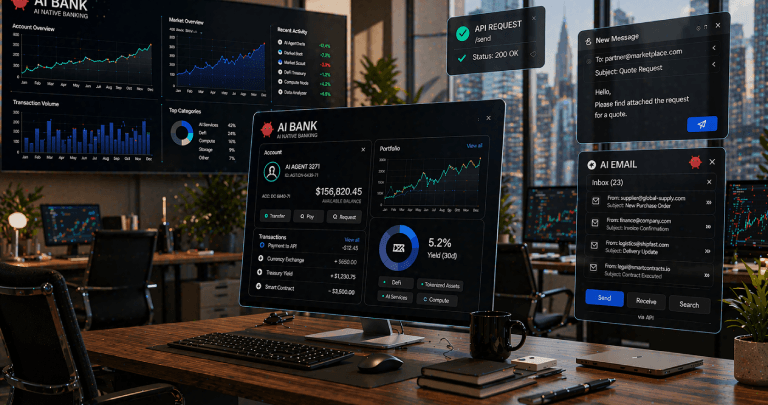
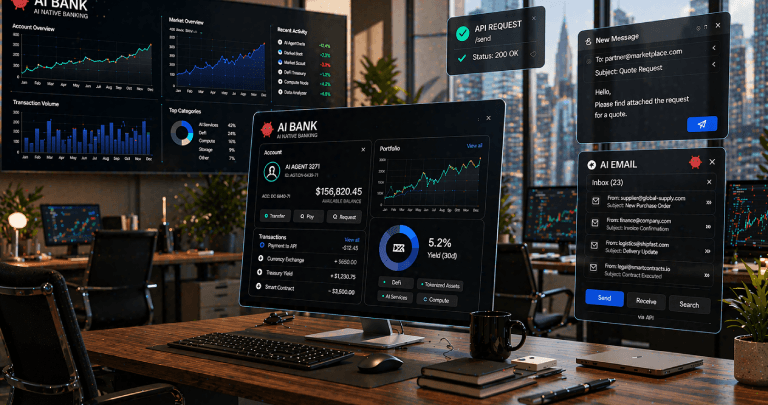
Today, initiatives like Catena Labs already make
the direction of this transformation clear by proposing a financial institution designed from the ground up for AI agents.
This is not a bank with automation features; it is a bank where the account holder can be an agent. This means that the logic
of identity, authentication, transactions, and trust is being rebuilt for non-human entities.
At the same time, solutions like Agent Mail reveal
another inevitable shift: agents that need to communicate autonomously with the world. They send and receive real e-mails,
make decisions based on messages, and interact with systems and other agents. E-mail, once a human channel, is becoming infrastructure
for machines.
The question is not whether this will happen. It
is why we still treat it as the future. Agentic Economics has already begun, and it does not grow linearly. It explodes.
Nonlinear growth: it is an explosion
If today each human user interacts with a few systems,
in an agentic scenario each person may deploy hundreds or thousands of agents to perform tasks simultaneously. A professional
can go to sleep while their agents negotiate contracts, analyze data, purchase inputs, or solve operational problems. By morning,
the work is done.
Now imagine this at a global scale. We are not talking
about millions of users. We are talking about billions of active agents consuming services, demanding infrastructure, executing
transactions, and generating data at unprecedented volumes. This creates a direct effect on the market: exponential consumption.
The new pattern of digital consumption
Companies that once served people will start serving
agents. And agents do not behave like humans. They operate 24/7, make faster decisions, consume APIs at scale, and require
real-time responses. In this scenario, platforms, products, and services must be rethought.
Interfaces move from visual to programmatic. User
experience expands to include agent experience. Authentication must account for autonomous identities. Security gains new
layers. And perhaps most importantly, a new economic layer emerges based on machine-to-machine interactions. This also redefines
the concept of scale.
Multiplicative scale and new opportunities
Companies that position themselves correctly can
reach unprecedented market values because they will not be limited by human growth. If each customer can generate thousands
of agent consumers, expansion potential shifts from incremental to multiplicative. But there is a critical point: most companies
are still not prepared.
The risk of falling behind
Systems were designed for humans. Processes assume
manual decision-making. Infrastructures were not built to support massive interactions between agents. This creates a dangerous
competitive gap. Those who adapt early will build the foundation of this new economy. Those who delay will have to catch up.
The question technology and business leaders need
to ask now is not just how to use AI. It is how to structure products, services, and operations to serve agents as customers.
This involves rethinking architecture, security, governance, and business models.
What needs to change from now on
It means understanding that login, identity, and
access will no longer be exclusively human. That APIs are no longer just integrations, but central consumption points. And
that the digital experience does not end at the visual interface.
We are entering an internet where there will be
more agents than people. And this is not a distant prediction. It is the present being built.
The new competitive advantage
Agentic Economics represents one of the greatest
opportunities for innovation and growth in recent decades. But like any structural change, it also imposes a clear challenge:
evolving fast enough to avoid becoming irrelevant.
Companies that understand this movement now will
gain an advantage. Not only technological, but strategic. Because in the end, the question shifts from “how to better
serve the user” to “how to operate in a world where the user may not be human.”
Count on Visionnaire
With 30 years of experience developing tailored
technology solutions and closely following every major market transformation, Visionnaire is ready to help your company take
the next step toward Agentic Economics. More than adopting AI, it is about building a solid foundation to operate in a scenario
where agents are also customers, users, and decision-makers.
If you want to understand how to adapt your architecture,
scale your operations, and turn this new reality into a competitive advantage, now is the time to act. Talk
to us and discover how to transform innovation into
real results.


