

From generative AI to autonomous agents, discover how to scale innovation with an AI Factory
Digital transformation has evolved, and fast. Just
a few years ago, investing in a Software Factory was enough to put companies ahead. Today, that is only the starting point.
The new competitive edge lies in something deeper: transforming data, interactions, and operations into real, scalable, and
continuous intelligence.
It is within this context that the AI Factory emerges,
more mature and strategic. But attention: the concept has also evolved. We are no longer just talking about automation or
isolated intelligent models. We are talking about a new production model, where intelligence is built, orchestrated, and scaled
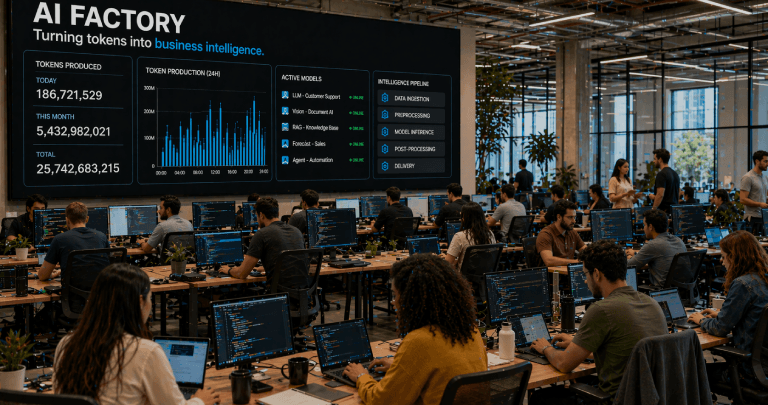
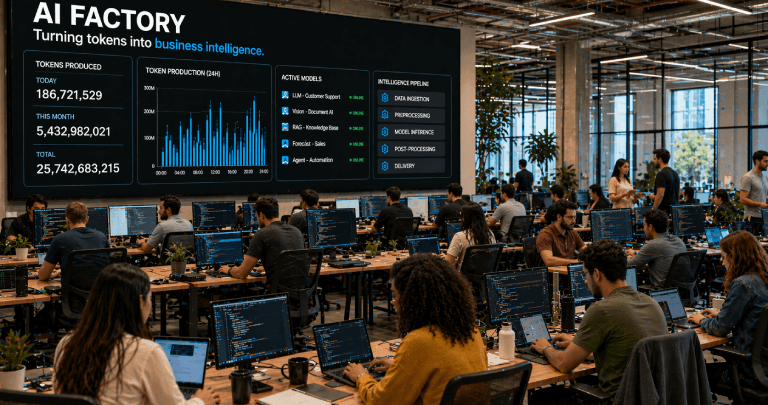
as a business asset. And increasingly, this intelligence has a well-defined raw material: tokens.
AI Factory: what has really changed?
An AI Factory remains a structured environment to
create, train, integrate, and maintain Artificial Intelligence-based solutions. However, today it operates at a much more
advanced level than before. While the focus used to be on developing models, it is now on orchestrating intelligence.
With the evolution of Large Language Models (LLMs),
generative AI, and autonomous agents, companies are now dealing with something new: systems that not only respond but also
make decisions, execute tasks, and continuously learn. This completely changes the game.
The AI Factory is no longer just a development center,
it becomes a strategic hub of applied intelligence, connecting data, models, processes, and people in real time.
Tokens: the new fuel of intelligence
In recent years, leaders such as Jensen Huang (NVIDIA)
and Andrew Ng have reinforced a powerful idea: tokens are the new energy. Tokens are the basic units of processing in modern
AI. Every word, command, context, or interaction goes through this “atom of intelligence.” The more tokens a company
processes, with quality, the more intelligence it generates. This creates a new market dynamic.
Just as we consume electricity on demand, we are
entering an era where intelligence is consumed in the same way. Tokens are increasingly seen as an essential service.
But here is the critical point: generating tokens
is not the same as generating value. Visionnaire is not a token factory like major infrastructure players. It is something
more strategic: an Intelligence Factory. In other words, it transforms tokens into decisions, efficiency, automation, and
real competitive advantage.
What a modern AI Factory truly delivers
In practice, an advanced AI Factory operates across
multiple fronts, always connecting technology to real business challenges. It begins with the creation of tailor-made solutions,
developing customized models that respect each company’s context, data, and objectives. This ensures precision and relevance,
something impossible with generic solutions.
It then advances into the intensive use of generative
AI, copilots, and intelligent agents, which now go far beyond chatbots. We are talking about systems capable of interpreting
scenarios, suggesting actions, and even executing complex tasks autonomously.
Automation has also evolved. It is no longer just
about eliminating repetitive tasks, but about creating intelligent workflows that adapt, learn, and continuously optimize
themselves.
Another critical point is the direct impact on software
development. AI is no longer just a feature of the final product; it has become a central part of the development process
itself. Today, it accelerates coding, testing, documentation, and architecture, drastically reducing delivery time and increasing
quality.
And perhaps most strategically: value-driven consulting.
In a scenario where everything seems possible with AI, knowing where to invest becomes just as important as knowing how to
implement.
The impact of the recent ai revolution on companies
Over the past 12 months, AI evolution has been exponential.
More efficient models have reduced processing costs. AI-assisted development tools have become standard. And so-called AI
agents have begun moving from concept to real-world applications.
For companies, this has brought three direct changes.
The first is speed. Projects that once took months can now be prototyped in weeks or even days. The second is accessibility.
AI is no longer exclusive to large corporations; it is now viable for companies of all sizes. The third, and most important,
is a shift in mindset. AI is no longer an isolated project. It is a strategic layer that spans the entire business. And this
is exactly where the AI Factory becomes essential.
Visionnaire: from Software Factory to Intelligence
Factory
With 30 years of experience, Visionnaire evolves
alongside the market, and often ahead of it.
Visionnaire combines technical expertise,
business knowledge, and mastery of new AI technologies to deliver solutions that truly work in practice. This is not about
experimenting with AI. It is about operationalizing intelligence. And that includes everything from integrating with legacy
systems to creating modern architectures based on agents, copilots, and intelligent automation.
The future will not only be digital, it will
be intelligent
Companies that still treat AI as a trend risk falling
behind. What we are witnessing now is the consolidation of a new global infrastructure based on intelligence. Tokens are the
fuel. Models are the engines. But it is the companies that know how to apply them that truly win.
An AI Factory is no longer a differentiator. It
is the safest path to transforming technology into results. And Visionnaire is ready to be that partner. Learn more here and get in touch with us.


